Monday, February 18, 2013
San Antonio River, Mission Reach, "Teddy" Roosevelt Park Trailhead,
once around the loop trail
Today's photos:
On President's Day last year, I walked at Eisenhower Park, so this year it was Theodore "Teddy" Roosevelt Park's turn. Teddy Roosevelt visited San Antonio on several occasions and always stayed at the Menger Hotel. His best known visit was in 1898 when he recruited the "Rough Riders" using the Menger Hotel bar as his "recruiting station."
Roosevelt's first visit to San Antonio, however, was in 1892 when he participated in a javelina hunt. Roosevelt was an avid hunter, but to the best of my knowledge (which is admittedly limited in this subject), there is no detailed record of where he hunted in the San Antonio area. I can't help but wonder if he spent some time hunting along the San Antonio River.
Of course, the habitat along the River has changed dramatically since Roosevelt's visits. One of the primary goals of the San Antonio River Restoration Project is to return the River to something of the character the River had around the time of Roosevelt's last visit to San Antonio about a hundred years ago.
This restoration process is still in the early stages. So here is a bit of what I saw and photographed today:
- The first photo is a Great Blue Heron.
- The second photo is a Little Blue Heron.
- The third, fourth and fifth photos are of a Spotted Sandpiper. If you look closely at its breast, the summer spotted plumage is beginning to return.
- The sixth photo is a Double-crested Cormorant.
- The seventh photo is an Eastern Black Nightshade. Like most nightshades, the fruit is toxic.
- The eighth photo is a Familiar Bluet damselfly.
- The ninth photo is a Firewheel flower. It is amazing the range of variation these flowers in the same species can have.
- The tenth photo is a pair of Red-tailed Hawks perched atop the old Lone Star Brewery smokestack.
- In the eleventh and twelfth photos, I had looked away from the smokestack for a minute or two and when I looked back, only the female red-tailed hawk remained perched at the top.
- The thirteenth photo is of two slider turtles sunning themselves on rocks in the River. This was a very warm sunny day and there were numerous turtles out on the rocks.
- The fourteenth photo is of a Texas Mountain Laurel in full bloom with a bee coming to gather nectar.
- The fifteenth photo* is an Anacacho Orchid Tree which is not actually an orchid, but a legume.
- The sixteenth photo is a male Gadwall.
* This post has been updated 2/19/2013 at 12:45 PM to provide the correct identification for the plant in this photo.
Sunday, February 17, 2013
An Impulse to Soar
"One can never consent to creep when one feels an impulse to soar." - Helen Keller, The Story of My Life
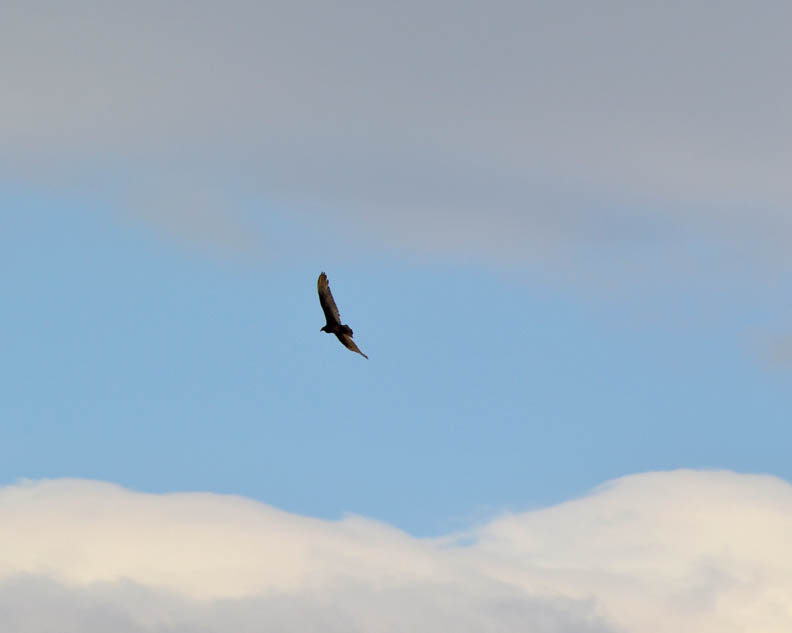
The turkey vulture may not be the most glamorous bird, but no other bird can soar the way they soar. These vultures are, quite literally, the pure embodiment of soaring. Their skill at navigating thermals is unmatched. The turkey vulture soaring amidst the clouds is a phenomenal sight to experience.
This set of photos was taken on my walk in Stone Oak Park this past Friday, February 15, 2013.
Friday, February 15, 2013
Stone Oak Park, North Loop Trail, the short loop
Today's photos:
Stone Oak Park (pdf map) is the next flood control retention basin upstream from Mud Creek Park. It is also a critical Edwards Aquifer recharge site, as it is the location of two caves, Bear Cave and Cub Cave, that serve as major aquifer recharge intake features. This is the first time I have walked at Stone Oak Park.
- The first and second photos are of a Turkey Vulture. There were numerous turkey vultures soaring above the park.
- The third photo is a Dainty Sulphur.
- The fourth photo is an Orange Sulphur.
- The fifth photo is an American Snout.
- The sixth, seventh and eighth photos are of a Painted Lady.
- The ninth photo is of another American Snout. The American snout appeared to be the most numerous of the many butterfly species that were active today.
- The tenth photo is a Prairie Verbena.
- The eleventh photo is a very ragged Red Admiral.
- The twelfth and thirteenth photos are of a Phaon Crescent.
- The fourteenth photo is the ragged Red Admiral again, but this time there is also a Spotless Lady Beetle.
- The fifteenth photo are more Prairie Verbena.
- The sixteenth, seventeenth and eighteenth photos are of a Queen.
- The nineteenth through the twenty-second photos are of Goldeneye Phlox. In the twentieth photo, there is a tiny green sider* on the edge of the petal on the right side of the flower and in the twenty-first photo there is a small insect* from the order Hymenoptera gathering nectar from the flower.
- The twenty-third photo is of a Prairie Verbena growing from a crack in a limestone slab.
- The twenty-fourth photo is of a plant* growing on a limestone outcropping.
* If I am able to more specifically identify the spider, insect and plant, I will update this post.