Wednesday, July 31, 2013
Medina River Natural Area,
El Chaparral > Nogales > Rio Medina > El Camino trail loop
Today's photos:
It is that time of year again in South Texas when everyone is beginning to wonder if Autumn will ever arrive and bring cooler weather. In spite of the seemingly endless high temperature and to some extent, because of the high temperature, the South Texas landscape retains a vibrant character. My intense curiosity and passionate love of Nature irresistibly draw me out to experience the rich beauty of her elegant living tapestry:
- The first three photos are of a Snowy Egret feeding in the pond beside the El Chaparral Trail.
- The fourth through sixth photos are of Purple Threeawn. The inflorescence has fully matured losing its characteristic purple color and is beginning to disarticulate.
- The seventh and eighth photos are of fully ripe, bright orange Granjeno berries.
- The ninth photo is of a Turkscap patch with a couple of Common Wild Petunias peeking out in the center of the patch. The Turkscap are one of the more abundant flowers blooming in the hot, dry weather right now providing a rich source of nectar that will help the pollinators survive through the harsh South Texas summer.
- The tenth photo is a Common Mestra butterfly on Canadian Wildrye.
- The eleventh through fourteenth photos are of a Gulf Fritillary butterfly enjoying the Turkscap nectar.
- The fifteenth photo is a Cloudless Sulphur butterfly on an Alamo Vine flower.
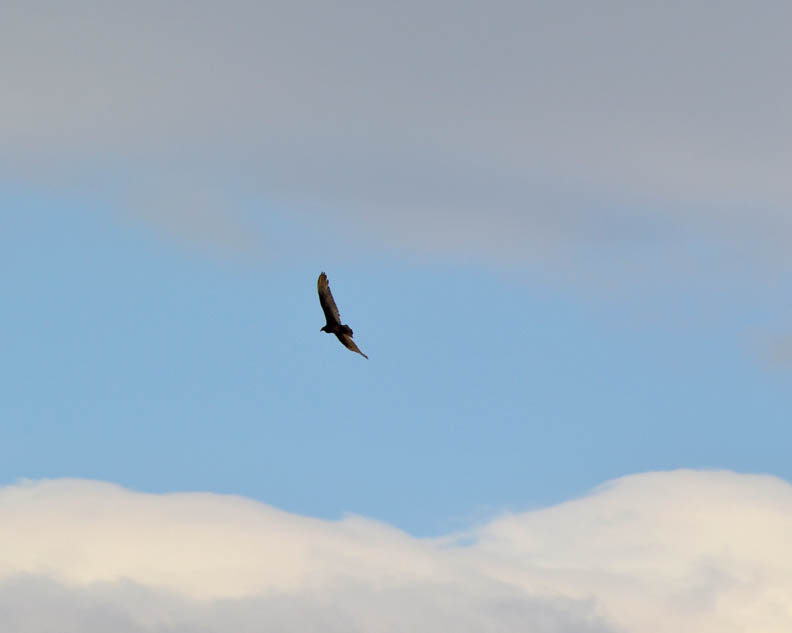
- The sixteenth and seventeenth photos are a Turkey Vulture soaring high overhead.
- The eighteenth photo is the shell of a freshwater mussel with a couple of river worn rocks on a mat of algae at the edge of the river.
- The nineteenth photo is an overview of the Medina River. This is the large pool looking upstream form the "River Crossing" interpretive area.
- The twentieth photo is a Texas Rose-bellied Lizard.
Friday, February 22, 2013
Hardberger Park, Oak Loop Trail
Today's photos:
I arrived at Hardberger Park fairly late in the afternoon. As so often happens at this time of the day, the quality of the light helped set the mood. The woods acquire something of a magical aura as the sun lowers towards the horizon.
- The first two photos are an American Crow. The distinctive "caw, caw, caw" the crow cried out attracted my attention before I actually saw the bird emerge from above the woods.
- The third and fourth photos are a White-winged Dove that was keeping close watch over the trail.
- The fifth photo is an Agarita shrub in full bloom. The agarita were the only flowers I saw blooming along the trail.
- The sixth photo is a Christmas Cactus also known as the Christmas cholla and tasajillo. Along with the numerous prickly pear clusters, the Christmas cactus grows in abundance in this area of the park.
- The seventh and eighth photos are Live Oak trees from which the Oak Loop Trail gets its name. The woods in this area is dominated by the live oaks. There are also some Ashe Juniper growing in the area. As can be seen in the eighth photo, the Texas Persimmon provides much of the lower understory growth, As a matter of fact, there is so much Texas persimmon growing along the trail, this could just as well be called the "Persimmon Loop Trail," but I guess that doesn't quite have the same appeal to it.
- The ninth photo is a close up of a Texas Persimmon trunk with its distinctive smooth bark.
- The tenth photo is a family of White-tailed Deer that were walking along the tree line along the edge of the recently cleared savannah restoration area. The PVC pipes are the irrigation system for the restoration project. This spring the newly planted prairie grasses will grow tall enough to hide the irrigation system from view.
- The eleventh, twelfth and thirteenth photos are a Turkey Vulture soaring through the evening sky above the savannah restoration area.
- The moon is the most obvious object in the fourteenth photo. Somewhat less obvious, but equally important, are the thin, wispy cirrus clouds being blown along in the jet stream high overhead.
- The fifteenth photo is another close up of a Texas Persimmon.
Sunday, February 17, 2013
An Impulse to Soar
"One can never consent to creep when one feels an impulse to soar." - Helen Keller, The Story of My Life
The turkey vulture may not be the most glamorous bird, but no other bird can soar the way they soar. These vultures are, quite literally, the pure embodiment of soaring. Their skill at navigating thermals is unmatched. The turkey vulture soaring amidst the clouds is a phenomenal sight to experience.
This set of photos was taken on my walk in Stone Oak Park this past Friday, February 15, 2013.
Friday, February 15, 2013
Stone Oak Park, North Loop Trail, the short loop
Today's photos:
Stone Oak Park (pdf map) is the next flood control retention basin upstream from Mud Creek Park. It is also a critical Edwards Aquifer recharge site, as it is the location of two caves, Bear Cave and Cub Cave, that serve as major aquifer recharge intake features. This is the first time I have walked at Stone Oak Park.
- The first and second photos are of a Turkey Vulture. There were numerous turkey vultures soaring above the park.
- The third photo is a Dainty Sulphur.
- The fourth photo is an Orange Sulphur.
- The fifth photo is an American Snout.
- The sixth, seventh and eighth photos are of a Painted Lady.
- The ninth photo is of another American Snout. The American snout appeared to be the most numerous of the many butterfly species that were active today.
- The tenth photo is a Prairie Verbena.
- The eleventh photo is a very ragged Red Admiral.
- The twelfth and thirteenth photos are of a Phaon Crescent.
- The fourteenth photo is the ragged Red Admiral again, but this time there is also a Spotless Lady Beetle.
- The fifteenth photo are more Prairie Verbena.
- The sixteenth, seventeenth and eighteenth photos are of a Queen.
- The nineteenth through the twenty-second photos are of Goldeneye Phlox. In the twentieth photo, there is a tiny green sider* on the edge of the petal on the right side of the flower and in the twenty-first photo there is a small insect* from the order Hymenoptera gathering nectar from the flower.
- The twenty-third photo is of a Prairie Verbena growing from a crack in a limestone slab.
- The twenty-fourth photo is of a plant* growing on a limestone outcropping.
* If I am able to more specifically identify the spider, insect and plant, I will update this post.