Tuesday, February 19, 2013
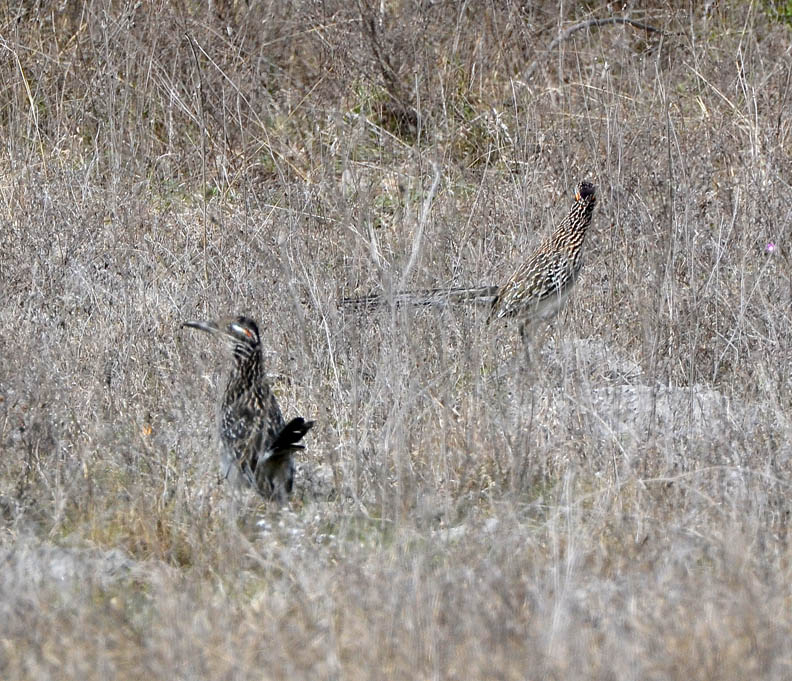
But wait. There wasn't just one Greater Roadrunner out in the savannah at Stone Oak Park. There was actually a pair of roadrunners. Male and female roadrunners have a very similar appearance. Females are a bit smaller and lighter in color than the males. These birds, like most, are monogamous, so it was not surprising to see a pair of them together:
Sunday, February 17, 2013
An Impulse to Soar
"One can never consent to creep when one feels an impulse to soar." - Helen Keller, The Story of My Life
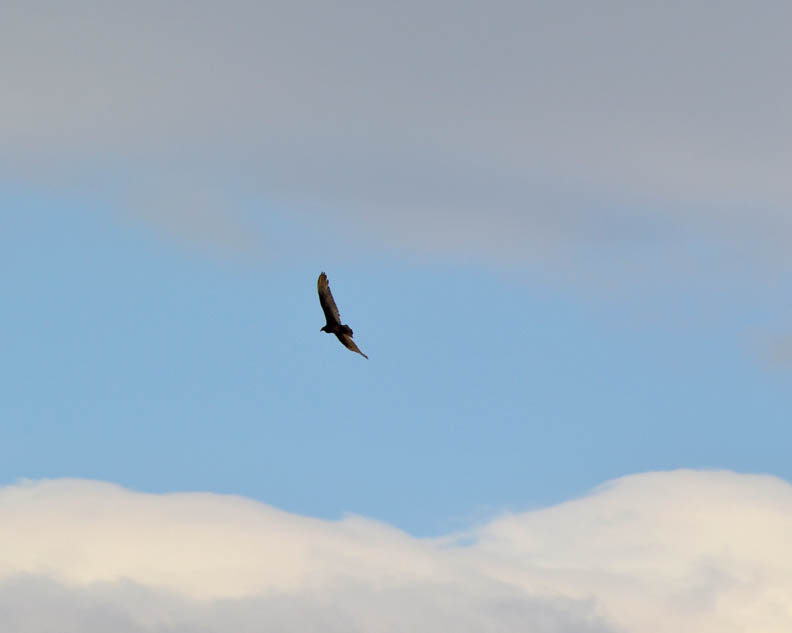
The turkey vulture may not be the most glamorous bird, but no other bird can soar the way they soar. These vultures are, quite literally, the pure embodiment of soaring. Their skill at navigating thermals is unmatched. The turkey vulture soaring amidst the clouds is a phenomenal sight to experience.
This set of photos was taken on my walk in Stone Oak Park this past Friday, February 15, 2013.
Friday, February 15, 2013
Stone Oak Park, North Loop Trail, the short loop
Today's photos:
Stone Oak Park (pdf map) is the next flood control retention basin upstream from Mud Creek Park. It is also a critical Edwards Aquifer recharge site, as it is the location of two caves, Bear Cave and Cub Cave, that serve as major aquifer recharge intake features. This is the first time I have walked at Stone Oak Park.
- The first and second photos are of a Turkey Vulture. There were numerous turkey vultures soaring above the park.
- The third photo is a Dainty Sulphur.
- The fourth photo is an Orange Sulphur.
- The fifth photo is an American Snout.
- The sixth, seventh and eighth photos are of a Painted Lady.
- The ninth photo is of another American Snout. The American snout appeared to be the most numerous of the many butterfly species that were active today.
- The tenth photo is a Prairie Verbena.
- The eleventh photo is a very ragged Red Admiral.
- The twelfth and thirteenth photos are of a Phaon Crescent.
- The fourteenth photo is the ragged Red Admiral again, but this time there is also a Spotless Lady Beetle.
- The fifteenth photo are more Prairie Verbena.
- The sixteenth, seventeenth and eighteenth photos are of a Queen.
- The nineteenth through the twenty-second photos are of Goldeneye Phlox. In the twentieth photo, there is a tiny green sider* on the edge of the petal on the right side of the flower and in the twenty-first photo there is a small insect* from the order Hymenoptera gathering nectar from the flower.
- The twenty-third photo is of a Prairie Verbena growing from a crack in a limestone slab.
- The twenty-fourth photo is of a plant* growing on a limestone outcropping.
* If I am able to more specifically identify the spider, insect and plant, I will update this post.