I have no doubt that animals sense impending changes in the weather. I have written in another venue about how the squirrels here have put on an unusually heavy winter coat this year, while the National Weather Service has forecast a warmer than average winter. We have a long winter ahead, but so far, the squirrels have been well-served with their heavy coats.
I can't help but wonder if these slider turtles sensed the approaching arctic cold front and were out on the rocks taking advantage of the remaining warmth before the front arrived. The backlight from the reflection of the overcast sky adds to the sense of impending change:
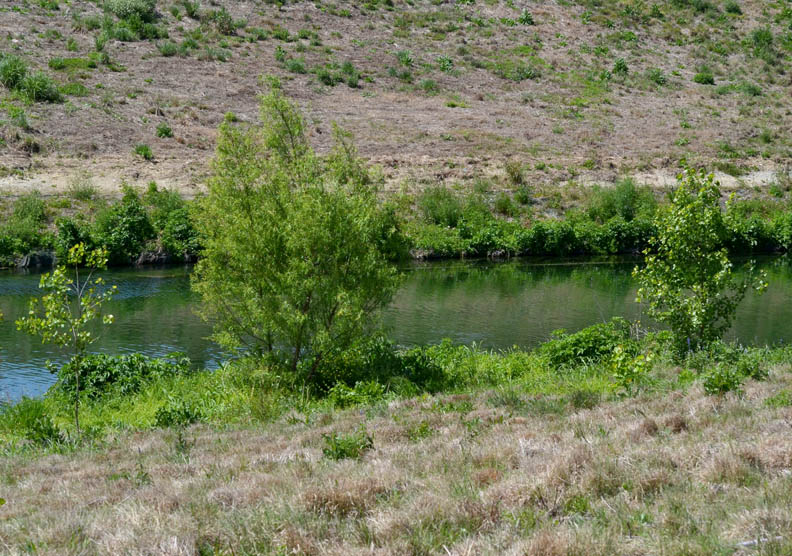
This set of photographs was taken near the Roosevelt Park Trailhead on the San Antonio River Mission Reach Wednesday, December 4, 2013.
Midday Monday, the sky was the purest deep blue that I have seen here in San Antonio in a long time. The intense blue of the calm river water is a reflection of the sky. The slider turtles were out taking full advantage of the bright sun shining through the clear sky. Turtles, like most other reptiles, take advantage of the sun to help regulate their body temperature:
If we could communicate with turtles, I suspect we would learn much about life. They spend a lot of their time silently observing all that occurs around them. From the personal experience of having shared my backyard with a Red-eared Slider Turtle for twenty some odd years, I know firsthand just how observant and surprisingly intelligent these turtles are.
This set of photographs was taken on the Mission Reach at the confluence of the San Antonio River and San Pedro Creek on Monday, October 7, 2013.
Wednesday, April 3, 2013
A much needed widespread, soaking rain fell overnight and into this afternoon. I took a much needed day off from a walk today. In case you haven't noticed, we do tend to celebrate some of the small things in life here, like rain. Water, after all, is one of the four necessary requirements (water, food, shelter, space) in a habitat.
The water level in the oxbow lake on Leon Creek was higher than I had anticipated it would be this past Monday (April 1, 2013). In spite of the lower than normal rainfall this year, the water table seems to be remaining reasonably well saturated. Where there is water in Bexar County, there will likely be a diverse range of fauna:
Following the rain today, I suspect this small lake is now a little bit deeper.
- The first two photos are a small slider turtle that has climbed fairly high up a branch that had fallen into the water.
- The third photo is a male Gadwall. Its mate was just a little too far to the side to get both in the photo.
- The fourth photo is an "armada" of slider turtles, some with only their heads sticking up out of the water.
- The fifth and sixth photos are an American Coot on the left and a Pied-billed Grebe on the right.
- The seventh photo is a closer view of the Pied-billed Grebe.
- The eighth through tenth photos are the American Coot.
- The eleventh through fourteenth photo are a male Black-bellied Whistling Duck. He apparently wasn't planning on going anywhere anytime soon as he pulled his right leg up and tucked it out of sight against his body.
- The fifteenth photo is the male Black-bellied Whistling Duck with its mate to the right in this photo.
Monday, March 25, 2013
San Antonio River, Mission Reach, Concepcíon Park Trailhead
between the confluence with Concepcíon Creek downstream and
the first riffle beyond the pedestrian footbridge upstream
Today's photos:
To make sense of the world we live in, to give it meaning and manage our lives, we make abstractions of the reality within which we live. We discuss ecosystems in terms of whether it is riparian or upland. What grasses, forbs, trees and fauna live in the ecosystem? What stage of woody succession has the ecosystem achieved and has it reached its likely climax stage? How is the fragmentation of habitat from our developing the land impacting the ecosystem? The questions and the abstractions required to answer them are endless.
This process of abstraction is critically important in understanding the world within which we live. But then we set foot on the trail and suddenly realize an "ecosystem" is, in fact, a living, breathing biotic community whose life far exceeds our ability to contain it in abstractions. We are quickly confronted by the ineffable and reminded, as was Thoreau, that "in Wildness is the preservation of the World."*
- The first two photos are Texas Indian Paintbrush. I didn't realize until I began searching for the link for this flower how many species there are in the Genus Castilleja. Lady Bird Johnson and the Texas Department of Transportation are largely responsible for this species, Castilleja indivisa Engelm., growing along the Texas highways throughout the state.
- The third photo is an overview of the River not far downstream from the Theo Ave bridge. I included this photo here for two reasons. First, it shows a young Black Willow tree and two Sycamore saplings growing on the edge of the river bank. The roots of these trees are already stabilizing the soil along the bank and preventing erosion. As they grow larger, the trees will increasingly provide shade on the river, cooling the water and improving its aquatic habitat.
- The second reason for including this third photo is that it gives a fairly accurate impression of the current state of the vegetation along much of the river. The wildflowers shown in close up in the other photos, for the most part, are growing in clusters along the river. Hopefully, we will get a significant rain soon that will yield a lush growth of vegetation.
- The fourth photo is an eye to eye look at a Gulf Fritillary butterfly.
- The fifth photo is a Texas Dandelion growing next to a cluster of Baby Blue Eyes.
- The sixth photo is another Texas Dandelion. This flower's common name is based on the fact it is a native plant to much of Texas and it resembles a dandelion, although it is in a different Genus from true dandelions. It is an interesting coincidence that when the flowers are used to make dye, this bright yellow flower yields a University of Texas burnt orange dye color.
- The seventh and eighth photos are Bluebonnets. There is a Ladybug on one of the plants that particularly stands out because of the color contrast between the bright orange-red of the insect and the blue of the flowers.
- The ninth photo is a Scrambled Eggs. Note there is an insect on the right center flower. This appears to me to be a "sweat bee" in the Genus Lassioglossum, but don't quote me on that.
- The tenth photo is a group of slider turtles enjoying a Monday afternoon get together on a midstream rock to celebrate the warmth of the sun. The two turtles on the right are Red-eared Sliders. The turtle on the right is a slider, but it looks more like a Big Bend Slider. I don't know if the Big Bend Sliders have found their way this far east or if this one "hitched a ride" with a tourist who didn't know better than to move animals from one region to another. This turtle is definitely not a Red-eared Slider.
- The eleventh photo is one of the damselflies commonly found along the River. I am fairly certain this one is in the Genus Argia. It appears to me to be a Sooty Dancer (Argia lugens).
- The twelfth photo is a windblown Snowy Egret on a large rock at the top of a riffle.
- The thirteenth photo is a Scarlet Sage. These bright red flowers stand out from the background clutter making them easy to spot along the river bank.
- The fourteenth and fifteenth photos are Whitebrush also known as Bee Brush. A honey bee conveniently flew through the field of view in the fifteenth photo.
- The sixteenth and seventeenth photos are Pink Evening Primrose all aglow with the translucent light of the sun passing through them. Translucence always gives a dramatic edge to a photograph. In nature photography, I think it serves particularly well to visually symbolize the "inner light" of the life that is within us and within all of creation.
* I think it's worth mentioning here, Thoreau goes on in his essay, Walking, to write: "The cities import [the Wildness] at any price." The total cost budgeted for the San Antonio River Improvement Project is 358.3 million dollars. I doubt Thoreau ever imagined a city would ever pay that high a price to import (or in this case, restore) Wildness, but the benefits this project provides the community are, quite literally, priceless.
Monday, February 18, 2013
San Antonio River, Mission Reach, "Teddy" Roosevelt Park Trailhead,
once around the loop trail
Today's photos:
On President's Day last year, I walked at Eisenhower Park, so this year it was Theodore "Teddy" Roosevelt Park's turn. Teddy Roosevelt visited San Antonio on several occasions and always stayed at the Menger Hotel. His best known visit was in 1898 when he recruited the "Rough Riders" using the Menger Hotel bar as his "recruiting station."
Roosevelt's first visit to San Antonio, however, was in 1892 when he participated in a javelina hunt. Roosevelt was an avid hunter, but to the best of my knowledge (which is admittedly limited in this subject), there is no detailed record of where he hunted in the San Antonio area. I can't help but wonder if he spent some time hunting along the San Antonio River.
Of course, the habitat along the River has changed dramatically since Roosevelt's visits. One of the primary goals of the San Antonio River Restoration Project is to return the River to something of the character the River had around the time of Roosevelt's last visit to San Antonio about a hundred years ago.
This restoration process is still in the early stages. So here is a bit of what I saw and photographed today:
- The first photo is a Great Blue Heron.
- The second photo is a Little Blue Heron.
- The third, fourth and fifth photos are of a Spotted Sandpiper. If you look closely at its breast, the summer spotted plumage is beginning to return.
- The sixth photo is a Double-crested Cormorant.
- The seventh photo is an Eastern Black Nightshade. Like most nightshades, the fruit is toxic.
- The eighth photo is a Familiar Bluet damselfly.
- The ninth photo is a Firewheel flower. It is amazing the range of variation these flowers in the same species can have.
- The tenth photo is a pair of Red-tailed Hawks perched atop the old Lone Star Brewery smokestack.
- In the eleventh and twelfth photos, I had looked away from the smokestack for a minute or two and when I looked back, only the female red-tailed hawk remained perched at the top.
- The thirteenth photo is of two slider turtles sunning themselves on rocks in the River. This was a very warm sunny day and there were numerous turtles out on the rocks.
- The fourteenth photo is of a Texas Mountain Laurel in full bloom with a bee coming to gather nectar.
- The fifteenth photo* is an Anacacho Orchid Tree which is not actually an orchid, but a legume.
- The sixteenth photo is a male Gadwall.
* This post has been updated 2/19/2013 at 12:45 PM to provide the correct identification for the plant in this photo.