Thursday, March 28, 2013

Ecosystems Are Not Abstract Concepts

Monday, March 25, 2013

San Antonio River, Mission Reach, Concepcíon Park Trailhead
between the confluence with Concepcíon Creek downstream and
the first riffle beyond the pedestrian footbridge upstream

Today's photos:


To make sense of the world we live in, to give it meaning and manage our lives, we make abstractions of the reality within which we live. We discuss ecosystems in terms of whether it is riparian or upland. What grasses, forbs, trees and fauna live in the ecosystem? What stage of woody succession has the ecosystem achieved and has it reached its likely climax stage? How is the fragmentation of habitat from our developing the land impacting the ecosystem? The questions and the abstractions required to answer them are endless.

This process of abstraction is critically important in understanding the world within which we live. But then we set foot on the trail and suddenly realize an "ecosystem" is, in fact, a living, breathing biotic community whose life far exceeds our ability to contain it in abstractions. We are quickly confronted by the ineffable and reminded, as was Thoreau, that "in Wildness is the preservation of the World."*

  • The first two photos are Texas Indian Paintbrush. I didn't realize until I began searching for the link for this flower how many species there are in the Genus Castilleja. Lady Bird Johnson and the Texas Department of Transportation are largely responsible for this species, Castilleja indivisa Engelm., growing along the Texas highways throughout the state.
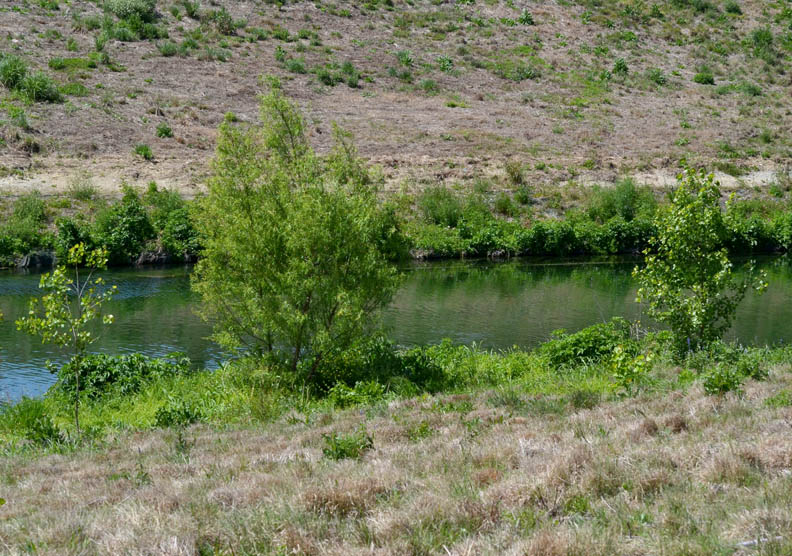
  • The third photo is an overview of the River not far downstream from the Theo Ave bridge. I included this photo here for two reasons. First, it shows a young Black Willow tree and two Sycamore saplings growing on the edge of the river bank. The roots of these trees are already stabilizing the soil along the bank and preventing erosion. As they grow larger, the trees will increasingly provide shade on the river, cooling the water and improving its aquatic habitat.
  • The second reason for including this third photo is that it gives a fairly accurate impression of the current state of the vegetation along much of the river. The wildflowers shown in close up in the other photos, for the most part, are growing in clusters along the river. Hopefully, we will get a significant rain soon that will yield a lush growth of vegetation.
  • The fourth photo is an eye to eye look at a Gulf Fritillary butterfly.
  • The fifth photo is a Texas Dandelion growing next to a cluster of Baby Blue Eyes.
  • The sixth photo is another Texas Dandelion. This flower's common name is based on the fact it is a native plant to much of Texas and it resembles a dandelion, although it is in a different Genus from true dandelions. It is an interesting coincidence that when the flowers are used to make dye, this bright yellow flower yields a University of Texas burnt orange dye color.
  • The seventh and eighth photos are Bluebonnets. There is a Ladybug on one of the plants that particularly stands out because of the color contrast between the bright orange-red of the insect and the blue of the flowers.
  • The ninth photo is a Scrambled Eggs. Note there is an insect on the right center flower.  This appears to me to be a "sweat bee" in the Genus Lassioglossum, but don't quote me on that.
  • The tenth photo is  a group of slider turtles enjoying a Monday afternoon get together on a midstream rock to celebrate the warmth of the sun. The two turtles on the right are Red-eared Sliders. The turtle on the right is a slider, but it looks more like a Big Bend Slider. I don't know if the Big Bend Sliders have found their way this far east or if this one "hitched a ride" with a tourist who didn't know better than to move animals from one region to another. This turtle is definitely not a Red-eared Slider.
  • The eleventh photo is one of the damselflies commonly found along the River. I am fairly certain this one is in the Genus Argia. It appears to me to be a Sooty Dancer (Argia lugens).
  • The twelfth photo is a windblown Snowy Egret on a large rock at the top of a riffle.
  • The thirteenth photo is a Scarlet Sage. These bright red flowers stand out from the background clutter making them easy to spot along the river bank.
  • The fourteenth and fifteenth photos are Whitebrush also known as Bee Brush. A honey bee conveniently flew through the field of view in the fifteenth photo.
  • The sixteenth and seventeenth photos are Pink Evening Primrose all aglow with the translucent light of the sun passing through them. Translucence always gives a dramatic edge to a photograph. In nature photography, I think it serves particularly well to visually symbolize the "inner light" of the life that is within us and within all of creation. 

* I think it's worth mentioning here, Thoreau goes on in his essay, Walking, to write: "The cities import [the Wildness] at any price." The total cost budgeted for the San Antonio River Improvement Project is 358.3 million dollars. I doubt Thoreau ever imagined a city would ever pay that high a price to import (or in this case, restore) Wildness, but the benefits this project provides the community are, quite literally, priceless.

Monday, March 25, 2013

Where Nature Heals and Gives Strength, A Sunday Special Edition

Sunday, March 24, 2013

Where Nature Heals and Gives Strength
"Everyone needs beauty as well as bread, places to play and pray, where nature heals and gives strength to body and soul alike."              -  John Muir


This set of photos was taken on my walk through the Medina River Natural Area on Wednesday, March 6, 2013:
  • I am fairly confident the first two photos are Windmillgrass in the Genus Chloris. I probably should stop there, but I'm going to climb out on a panicle (to the best of my knowledge grasses don't have limbs) and say this appears to me to be Shortspike Windmillgrass (Chloris subdolichostachya Muell.).
  • The third through fifth photos are a Dainty Sulphur butterfly. Typical of the Dainty Sulphur, this one wasn't spending much time on any one flower and in the fifth photo was flying on its way to find another flower. Update: March 25, 2013, 7:55 PM. It has been brought to my attention, the flower the Dainty Sulfur is perched on in this series of photos is a Huisache Daisy. Identifying the yellow composites can be an even bigger challenge than identifying grasses (or sparrows, or skipper butterflies). I admit I overlooked this flower in order to get the post published in a reasonable amount of time.
  • The sixth photo is a Bordered Patch butterfly.
  • The seventh and eighth photos are a Sleepy Orange butterfly.
  • The ninth through eleventh photos are a female Northern Cardinal. In the eleventh photo it had just taken off when I released the shutter and was flying a short distance away (and out of sight).
  • The twelfth through fourteenth photos are the female Cardinal's mate. The male Northern Cardinal's plumage is an even brighter red during mating season than the rest of the year. The tree in the background behind the male Cardinal is a Sugar Hackberry, sometimes referred to simply as a Sugarberry tree. The texture of the bark is one of the primary identifying characteristics for the Sugar Hackberry tree.
  • The fifteenth photo is a Pearl Crescent butterfly taking in the warmth of the sun while perched on a rock on the river bank..
  • The sixteenth and seventeenth photos are a Dewberry flower. This dewberry is known as the Zarzamora* in Spanish.
  • The eighteenth photo is a close up of some branches on a Granjeno shrub that was just beginning to set its leaves. One of the distinguishing characteristics for this shrub is the way the branches grow in a zigzag pattern. Also, the very large thorns, typical of many plants that grow in South Texas, are clearly visible in this photo. The Granjeno is a close cousin of the Sugar Hackberry and is sometimes called the Spiny Hackberry.
* In Spanish, the word Zarzamora refers to all the species in the Genus Rubus. This includes both blackberries and dewberries.

Sunday, March 24, 2013

Island in the Lake

Friday, March 22, 2013

Elmendorf Lake, On the large island
(with some photos from and back to the parking lot)

Today's photos:


This past Tuesday (March 19) I attended the Elmendorf Lake Park Conceptual Design Workshop cosponsored by the San Antonio River Authority and the City of San Antonio. At this meeting, the design team contracted to create a master plan for improvements to Elmendorf Lake Park (pdf link) presented initial design concepts and received community feedback for further consideration in the design process.

I am particularly interested in several items in the conceptual plan, such as a farmers' market and a community garden, but the one item that particularly caught my attention is the possibility of developing the "Island as Classroom." This part of the plan would improve the natural habitat on the island, incorporating specific teaching facilities for environmental and ecological studies and a dock for aquatic habitat studies. This concept for the island's improvement has tremendous potential.

So, for my walk today, I returned to Elmendorf Lake to take a closer look at the island.
  • The first and second photos are views of the Our Lady of the Lake University Main Building and the Sacred Heart Conventual Chapel as seen looking across from the east side of the lake. One of the primary goals of the park improvement master plan is to preserve and enhance the historic connection between the University, Elmendorf Lake and the surrounding community. This goal will be accomplished in part, by preserving existing sight lines such as the one illustrated by these two photos and by creating new visual corridors.
  • The third photo is a view from the east bank of the lake looking northwest at the southeast end of the large island. The trees on the island are primarily Huisache, which are currently in full bloom, Bald Cypress and Black Willow.
  • The fourth and fifth photos were taken from the east bank of the lake looking south along the edge of the island. The fifth photo is a close up of the Huisache seen overhanging the lake on the left end of the fourth photo.
  • The sixth photo is one of numerous Fox Squirrels that live in the park.
  • The seventh photo is a view of the smaller "Bird Island" as seen looking west from the northwest end of the large island. As can be seen in this photo, "Bird Island" is a rookery for countless egrets and cormorants. All of the egrets I could clearly identify when I took this photo were Snowy Egrets, but there are also some Great Egrets nesting on this island. The cormorants include both Double-crested and Neotropic species. This island is a critical nesting site for these birds and I certainly hope its preservation as such is included in the master plan.
  • The eighth photo is a Pipevine Swallowtail butterfly. This swallowtail was much more cooperative than the one I photographed Wednesday in Padre Park.
  • The ninth photo is a young Bald Cypress setting new leaves. This tree is growing on the bank of the southeast end of the large island.
  • The tenth photo is a view taken from the southwest bank of the large island looking north up the lake towards Commerce St. The vegetation growing along the banks of both the lake and the island are primarily Cattail and Elephant Ear. Both are very prolific and effectively stabilize the soil along the bank, but the native Cattail needs to be thinned out and the Elephant Ear, a non-native invasive plant, needs to be replaced with native plants such as Switchgrass or something similarly effective at bank stabilization.
  • The eleventh photo is a large Mexican Honey Wasp nest high up in a Bald Cypress on the bank of the lake. Mexican Honey Wasps are fairly common in Bexar County and are one of the most important native pollinating insects. They are one of very few species of insects other than bees capable of producing honey.
  • The twelfth photo is a close up of a Bald Cypress branch with freshly set new leaves.
  • The thirteenth through fifteenth photos are close ups of Black Willow flowers. The Honey Bees were taking full advantage of this ample supply of nectar.
  • The sixteenth photo is a Great Blue Heron on the large island as seen looking across the lake from the east bank. While the heron provides a visual point of interest in the photo, my primary reason for including the photo in this series is because it effectively shows how the landscape on the island is currently highly manicured in traditional park-like fashion. If the island is eventually developed as a classroom for environmental studies, the landscape should be wildscaped instead of manicured. 

As with my walk at Elmendorf Lake on January 7, I was again impressed by the number and diversity of species of birds around the lake. I took numerous photos of the birds and will publish them in two or three more posts in the near future.