Showing posts with label Gulf Fritillary. Show all posts

Saturday, November 9, 2013

The Butterfly with a Passion

I have published numerous posts in which I have discussed the relationship between the Gulf Fritillary butterfly and Passion Vine (Passiflora spp.). Passion Vine is the sole larval host plant for this fritillary. The adult Gulf Fritillary feeds on nectar from a wide variety of flowers. This one is savoring the nectar from Tropical Sage (Salvia coccinea) flowers:


This set of photographs was taken along the Mission Reach of the San Antonio River near the Roosevelt Park Trailhead on Thursday, October 31, 2013.

Thursday, March 28, 2013

Ecosystems Are Not Abstract Concepts

Monday, March 25, 2013

San Antonio River, Mission Reach, Concepcíon Park Trailhead
between the confluence with Concepcíon Creek downstream and
the first riffle beyond the pedestrian footbridge upstream

Today's photos:


To make sense of the world we live in, to give it meaning and manage our lives, we make abstractions of the reality within which we live. We discuss ecosystems in terms of whether it is riparian or upland. What grasses, forbs, trees and fauna live in the ecosystem? What stage of woody succession has the ecosystem achieved and has it reached its likely climax stage? How is the fragmentation of habitat from our developing the land impacting the ecosystem? The questions and the abstractions required to answer them are endless.

This process of abstraction is critically important in understanding the world within which we live. But then we set foot on the trail and suddenly realize an "ecosystem" is, in fact, a living, breathing biotic community whose life far exceeds our ability to contain it in abstractions. We are quickly confronted by the ineffable and reminded, as was Thoreau, that "in Wildness is the preservation of the World."*

  • The first two photos are Texas Indian Paintbrush. I didn't realize until I began searching for the link for this flower how many species there are in the Genus Castilleja. Lady Bird Johnson and the Texas Department of Transportation are largely responsible for this species, Castilleja indivisa Engelm., growing along the Texas highways throughout the state.
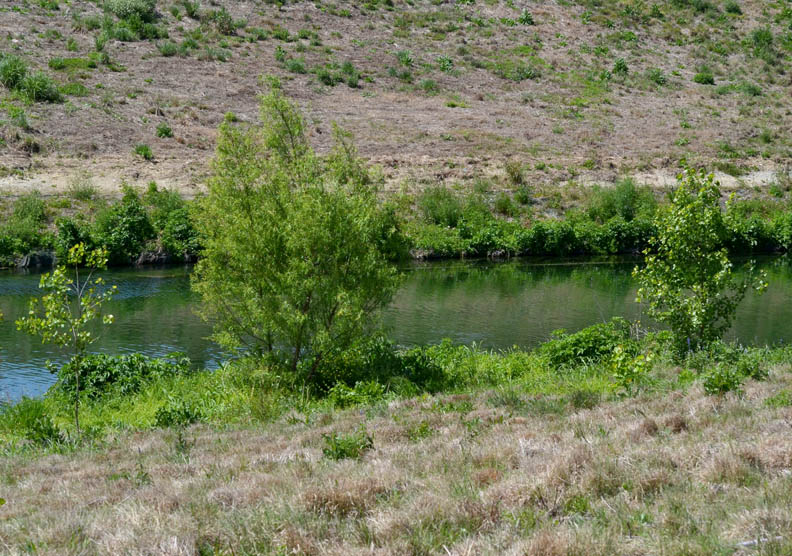
  • The third photo is an overview of the River not far downstream from the Theo Ave bridge. I included this photo here for two reasons. First, it shows a young Black Willow tree and two Sycamore saplings growing on the edge of the river bank. The roots of these trees are already stabilizing the soil along the bank and preventing erosion. As they grow larger, the trees will increasingly provide shade on the river, cooling the water and improving its aquatic habitat.
  • The second reason for including this third photo is that it gives a fairly accurate impression of the current state of the vegetation along much of the river. The wildflowers shown in close up in the other photos, for the most part, are growing in clusters along the river. Hopefully, we will get a significant rain soon that will yield a lush growth of vegetation.
  • The fourth photo is an eye to eye look at a Gulf Fritillary butterfly.
  • The fifth photo is a Texas Dandelion growing next to a cluster of Baby Blue Eyes.
  • The sixth photo is another Texas Dandelion. This flower's common name is based on the fact it is a native plant to much of Texas and it resembles a dandelion, although it is in a different Genus from true dandelions. It is an interesting coincidence that when the flowers are used to make dye, this bright yellow flower yields a University of Texas burnt orange dye color.
  • The seventh and eighth photos are Bluebonnets. There is a Ladybug on one of the plants that particularly stands out because of the color contrast between the bright orange-red of the insect and the blue of the flowers.
  • The ninth photo is a Scrambled Eggs. Note there is an insect on the right center flower.  This appears to me to be a "sweat bee" in the Genus Lassioglossum, but don't quote me on that.
  • The tenth photo is  a group of slider turtles enjoying a Monday afternoon get together on a midstream rock to celebrate the warmth of the sun. The two turtles on the right are Red-eared Sliders. The turtle on the right is a slider, but it looks more like a Big Bend Slider. I don't know if the Big Bend Sliders have found their way this far east or if this one "hitched a ride" with a tourist who didn't know better than to move animals from one region to another. This turtle is definitely not a Red-eared Slider.
  • The eleventh photo is one of the damselflies commonly found along the River. I am fairly certain this one is in the Genus Argia. It appears to me to be a Sooty Dancer (Argia lugens).
  • The twelfth photo is a windblown Snowy Egret on a large rock at the top of a riffle.
  • The thirteenth photo is a Scarlet Sage. These bright red flowers stand out from the background clutter making them easy to spot along the river bank.
  • The fourteenth and fifteenth photos are Whitebrush also known as Bee Brush. A honey bee conveniently flew through the field of view in the fifteenth photo.
  • The sixteenth and seventeenth photos are Pink Evening Primrose all aglow with the translucent light of the sun passing through them. Translucence always gives a dramatic edge to a photograph. In nature photography, I think it serves particularly well to visually symbolize the "inner light" of the life that is within us and within all of creation. 

* I think it's worth mentioning here, Thoreau goes on in his essay, Walking, to write: "The cities import [the Wildness] at any price." The total cost budgeted for the San Antonio River Improvement Project is 358.3 million dollars. I doubt Thoreau ever imagined a city would ever pay that high a price to import (or in this case, restore) Wildness, but the benefits this project provides the community are, quite literally, priceless.

Sunday, February 24, 2013

A Lesson in Interdependence, A Sunday Special Edition

Sunday, February 24, 2013

A Lesson in Interdependence
"In nature, nothing exists alone."  -  Rachel Carson, Silent Spring
"'Butterflies are not insects,' Captain John Sterling said soberly. 'They are self-propelled flowers.'"  -  R. A. Heinlein, The Cat Who Walks Through Walls


I have to admit I have not read The Cat Who Walks Through Walls, but I do know that Robert Heinlein's knowledge of science was quite thorough even while writing science fiction. I have little doubt when he wrote this line, he was aware of its full ecological implications. As Rachel Carson points out nothing in nature (including butterflies) exist alone.

Butterflies and the plants upon which the flowers grow are about as interdependent as any two groups of living organisms. If Milkweed is eliminated, there will be no Monarch butterflies. If Passion Vine, also known as maypop, is eliminated there will be no Gulf Fritillary butterflies. If there were no Pipevine, there will be no Pipevine Swallowtail butterflies. It is that simple.

The caterpillars of these three butterflies depend specifically on species of these three plants as a sole source of food. It is true for the majority of butterfly species that in the caterpillar stage they will only feed on a limited selection of plant species. In turn, any number of flowers depend on pollinator insects, such as butterflies, for reproduction.

When all is said and done, there is a fundamental existential truth to the statement that "butterflies are self-propelled flowers."

Of course, the butterfly / flower relationship is one of the most well defined examples of interdependence in nature. There is no species of life on Earth that does not depend on other species.

There is a constant dynamic equilibrium of interaction in the biotic community. Ultimately, if one species is significantly reduced or eliminated, the equilibrium throughout the community will change. If a key species is adversely affected, an entire community will be adversely impacted. A critical point to realize is that we humans rarely know until the damage is done which species are the key species.

The butterflies in the photos above where taken on my walk along the Mission Reach of the San Antonio River on Monday, February 18, 2013:
  • The first four photos are a Pipevine Swallowtail gathering nectar from Mountain Laurel flowers. In the fourth photo, the swallowtail was flying out of the frame of the camera, but I included the photo anyway because the butterfly's long, curved proboscis used for gathering nectar from the flowers is clearly visible.
  • The fifth through eighth photos are a Gulf Fritillary. In the fifth photo it is gathering nectar from the Mountain Laurel flowers. In the last three photos, the fritillary is feeding on Lantana flowers.

    Saturday, February 2, 2013

    Harbingers of Spring and a Few Other River Scenes

    Friday, February 1, 2013

    San Antonio River, Mission Reach, Roosevelt Park Trailhead
    once around the Roosevelt Park loop trail

    Today's photos:


    Yesterday and today I assisted the San Antonio River Authority with a Mission Reach education program for high school students. Since I was already at Roosevelt Park this afternoon, it made sense to go once around the loop one more time for my walk today.

    The first photo is a red-tailed hawk.

    The second, third and fourth photos are bluebonnet plants, the State Flower of Texas, that will soon be blooming.

    The fifth photo is a red-eared slider turtle.

    The sixth photo is an orange sulphur or one of its close cousins.

    The seventh photo is one double-crested and two neotropic cormorants.

    The eighth photo with the top of the Tower of the Americas in the background is of a hawk. It is soaring high above the river at a good distance upstream from where I was walking. I think this is the red-shouldered hawk that nests close to the Alamo St bridge.

    The ninth photo is of four slider turtles squeezing onto a single rock as slider turtles are prone to do to soak up the warmth of the sun.

    The tenth photo is a mealy blue sage in the process of blooming.

    The eleventh, twelfth and thirteenth photos are of a gulf fritillary gathering nectar from a cultivated variety of scarlet sage.

    The fourteenth and fifteenth photos are a huisache tree at the intersection of Lone Star Blvd and Mission Rd. This huisache is in full bloom.

    The sixteenth photo is of an Anacua tree, more commonly known as a sandpaper tree because of the very rough undersurface of the leaves. The leaves of the anacua have actually been used as a fine grit sandpaper.

    Monday, December 24, 2012

    Christmas Eve, Chasing Butterflies

    Christmas Eve, Monday, December 24, 2012

    San Antonio River, Eagleland Reach, Blue Star Trailhead downstream

    Today's photos:


    All I can say is, there is nothing quite like chasing butterflies (literally) on Christmas Eve. It isn't exactly what I expected to photograph as I drove to the River, but then I never quite know what I will encounter. What I encountered today was another abundance of butterflies, especially the gulf fritillaries and orange sulphurs, and other kinds of butterflies as well.