Showing posts with label Concepcíon Park Trailhead. Show all posts

Thursday, March 28, 2013

Ecosystems Are Not Abstract Concepts

Monday, March 25, 2013

San Antonio River, Mission Reach, Concepcíon Park Trailhead
between the confluence with Concepcíon Creek downstream and
the first riffle beyond the pedestrian footbridge upstream

Today's photos:


To make sense of the world we live in, to give it meaning and manage our lives, we make abstractions of the reality within which we live. We discuss ecosystems in terms of whether it is riparian or upland. What grasses, forbs, trees and fauna live in the ecosystem? What stage of woody succession has the ecosystem achieved and has it reached its likely climax stage? How is the fragmentation of habitat from our developing the land impacting the ecosystem? The questions and the abstractions required to answer them are endless.

This process of abstraction is critically important in understanding the world within which we live. But then we set foot on the trail and suddenly realize an "ecosystem" is, in fact, a living, breathing biotic community whose life far exceeds our ability to contain it in abstractions. We are quickly confronted by the ineffable and reminded, as was Thoreau, that "in Wildness is the preservation of the World."*

  • The first two photos are Texas Indian Paintbrush. I didn't realize until I began searching for the link for this flower how many species there are in the Genus Castilleja. Lady Bird Johnson and the Texas Department of Transportation are largely responsible for this species, Castilleja indivisa Engelm., growing along the Texas highways throughout the state.
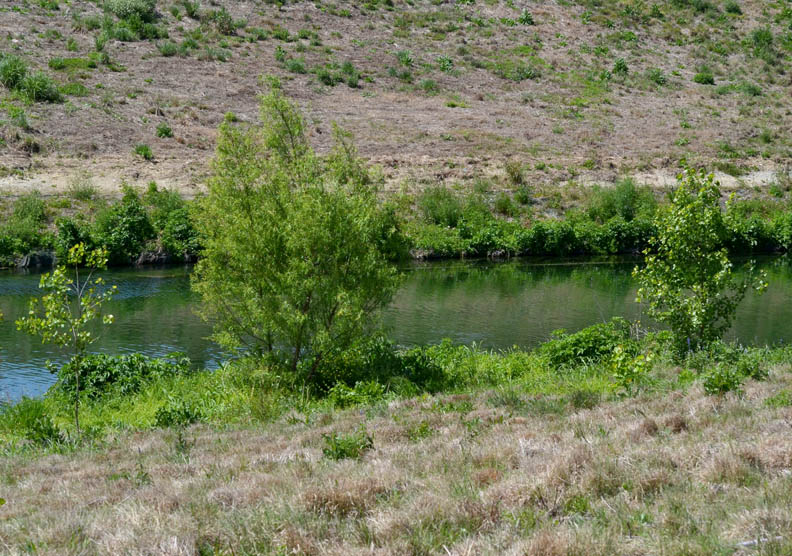
  • The third photo is an overview of the River not far downstream from the Theo Ave bridge. I included this photo here for two reasons. First, it shows a young Black Willow tree and two Sycamore saplings growing on the edge of the river bank. The roots of these trees are already stabilizing the soil along the bank and preventing erosion. As they grow larger, the trees will increasingly provide shade on the river, cooling the water and improving its aquatic habitat.
  • The second reason for including this third photo is that it gives a fairly accurate impression of the current state of the vegetation along much of the river. The wildflowers shown in close up in the other photos, for the most part, are growing in clusters along the river. Hopefully, we will get a significant rain soon that will yield a lush growth of vegetation.
  • The fourth photo is an eye to eye look at a Gulf Fritillary butterfly.
  • The fifth photo is a Texas Dandelion growing next to a cluster of Baby Blue Eyes.
  • The sixth photo is another Texas Dandelion. This flower's common name is based on the fact it is a native plant to much of Texas and it resembles a dandelion, although it is in a different Genus from true dandelions. It is an interesting coincidence that when the flowers are used to make dye, this bright yellow flower yields a University of Texas burnt orange dye color.
  • The seventh and eighth photos are Bluebonnets. There is a Ladybug on one of the plants that particularly stands out because of the color contrast between the bright orange-red of the insect and the blue of the flowers.
  • The ninth photo is a Scrambled Eggs. Note there is an insect on the right center flower.  This appears to me to be a "sweat bee" in the Genus Lassioglossum, but don't quote me on that.
  • The tenth photo is  a group of slider turtles enjoying a Monday afternoon get together on a midstream rock to celebrate the warmth of the sun. The two turtles on the right are Red-eared Sliders. The turtle on the right is a slider, but it looks more like a Big Bend Slider. I don't know if the Big Bend Sliders have found their way this far east or if this one "hitched a ride" with a tourist who didn't know better than to move animals from one region to another. This turtle is definitely not a Red-eared Slider.
  • The eleventh photo is one of the damselflies commonly found along the River. I am fairly certain this one is in the Genus Argia. It appears to me to be a Sooty Dancer (Argia lugens).
  • The twelfth photo is a windblown Snowy Egret on a large rock at the top of a riffle.
  • The thirteenth photo is a Scarlet Sage. These bright red flowers stand out from the background clutter making them easy to spot along the river bank.
  • The fourteenth and fifteenth photos are Whitebrush also known as Bee Brush. A honey bee conveniently flew through the field of view in the fifteenth photo.
  • The sixteenth and seventeenth photos are Pink Evening Primrose all aglow with the translucent light of the sun passing through them. Translucence always gives a dramatic edge to a photograph. In nature photography, I think it serves particularly well to visually symbolize the "inner light" of the life that is within us and within all of creation. 

* I think it's worth mentioning here, Thoreau goes on in his essay, Walking, to write: "The cities import [the Wildness] at any price." The total cost budgeted for the San Antonio River Improvement Project is 358.3 million dollars. I doubt Thoreau ever imagined a city would ever pay that high a price to import (or in this case, restore) Wildness, but the benefits this project provides the community are, quite literally, priceless.

Tuesday, February 26, 2013

Wind Blown

Monday, February 25, 2013

San Antonio River, Mission Reach, Concepcíon Park Trailhead
the downstream loop trail

Today's photos:


The weather story today here in Bexar County was the high wind. This afternoon while I was walking, the wind was blowing at about 28 mph sustained with gusts between 40 and 45 mph. There were a few grass fires around the area (one with fatalities), but falling trees and blowing debris were the bigger problems.

It seemed to me the River greenway trail was probably the safest place for a walk. The primary disadvantage was there are few windbreaks along the open river channel. Holding the camera steady enough to take the photos was quite a challenge at times. But then, just standing up in the higher wind gusts was also a challenge.

In spite of the wind, I still took at least as many photos on this walk as I usually do on any walk along the River. This is just a sample. There are enough photos for two more posts in the near future.

  • The first two photos are Purple Threeawn. The wind was furiously lashing the grass around almost flattening it to the ground at times.
  • In the third and fourth photos, the tall dense stand of Cattail provided a windbreak on the river bank. A couple of Northern Shovelers, a few Gadwalls and a Little Blue Heron took advantage of a respite from the wind in its shelter.
  • The fifth and sixth photos are of a Pink Evening Primrose. Like all the other plants, this flower was taking a fairly severe beating as the wind whipped it around.
  • The seventh and eighth photos are a Snowy Egret.
  • The ninth through thirteenth photos are two Lesser Yellowlegs. There were several lesser yellowlegs feeding in the wind whipped water flowing down one of the riffles.
  • The fourteenth and fifteenth photos are a male Gadwall swimming in the rough, wind blown water at the center of the River channel.
  • The sixteenth and seventeenth photos are of three Killdeer. Along with the lesser yellowlegs, there were numerous killdeer. In the sixteenth photo, the killdeer that was flying higher above the water was having some difficulty navigating a wind gust, but it landed on a rock without any apparent difficulty. (They showed some planes landing at SA International Airport on the evening news. The large jumbo jets seemed to be having similar problems as they approached the runway.)
  • The eighteenth photo is a Loggerhead Shrike. It had a tight grip on the tree branch. If shrikes are concerned about such things, this one was definitely having a "bad feather day."

Tuesday, February 12, 2013

Texture and Fluidity

Monday, February 11, 2013

San Antonio River, Mission Reach, Concepcíon Park Trailhead upstream

Today's photos:


The weather changed again over the weekend, so today was more typical of mid-February here: a bit chilly, windy and overcast with scattered sprinkles that were too light to show up on the weather radar. However, compared to the destructive storms occurring in much of the rest of the U.S., our weather remains pleasantly mild.

As I was walking, I became particularly aware of the texture of the landscape; how it was reflecting the mood created by the weather, particularly with the wind rippling the surface of the river.
  • The first photo is a little blue heron. I couldn't help but wonder if this is one of the pair we have been seeing further upstream or if there are more little blues along the Mission Reach.
  • The second photo is a slider turtle sitting on a rock. It was an overcast day, so I don't think it would be correct to say it was "sunning" itself. As a matter of fact, this was the only turtle I saw the entire walk. What really fascinated me, however, was how the wind and the presence of the rock in the current affected the surface texture of the water.
  • The third and fourth photos are a snowy egret.
  • The fifth photo is a great blue heron flying over some power lines.
  • The sixth through the eleventh photos are of a spotted sandpiper, once again with spotless winter plumage, searching for food without any apparent trepidation of the water current going over the weir and down the riffle.
  • The twelfth photo is of water rushing down through a riffle. There aren't any birds or other creatures in the photo. The subject of the photo is the texture and fluidity of the scene itself.
  • The thirteenth photo is a pair of gadwalls.
  • The fourteenth photo is a fascinating tree branch pattern in one of the old pecan trees above the river in Concepcíon Park.
Publication update: As it turns out, the Sunday Special Edition that I had hoped to post this past Sunday still needs some more work, so it will be this coming Sunday's post. After all, life is a process that requires continuous adaptation.

Thursday, December 20, 2012

Greeted by an Osprey

Thursday, December 20, 2012

One of the osprey greeted me when I arrived at the River yesterday. It only circled once before flying off upstream, so I was only able to get a few photos of it. Numerous slider turtles* were out on the rocks basking in the warmth of the sun. Slider turtles seem to be social in nature, as they do tend to gather in groups when they are sunning themselves. And a couple of snowy egrets were finding plenty to eat at the top of a riffle:


* There are at least three species of slider turtles. I have read that all red-eared slider turtles have the red streak on their head. That is what defines the species. Quite a few of the slider turtles in Bexar County do not have the red streak, but otherwise appear to be red-eared sliders. One of the species is a yellow slider, but they apparently don't live this far west. When I get an opportunity to discuss this with a herpetologist, perhaps I'll be able to clarify exactly what the turtles without the red streak are.