Tuesday, March 12, 2013
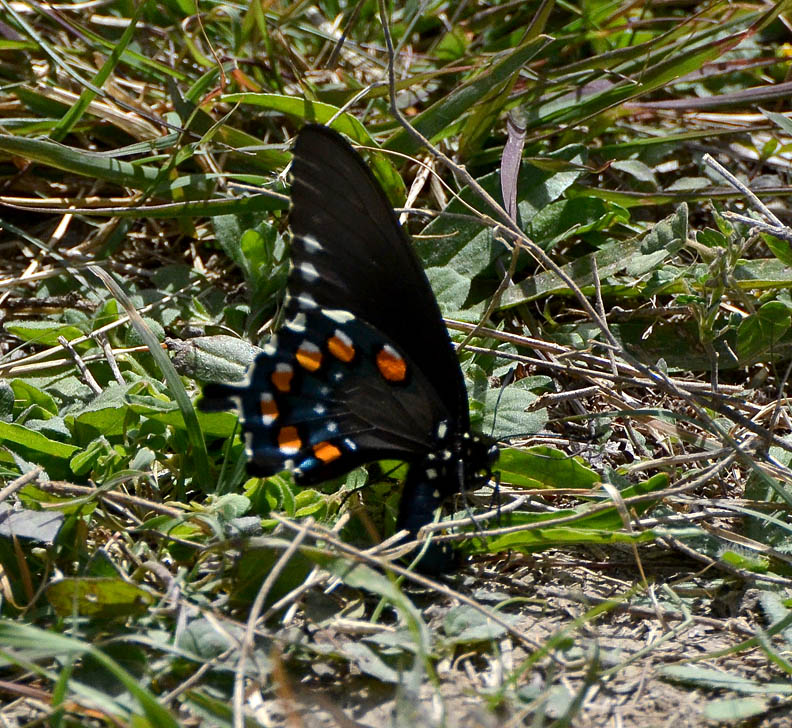
The Pipevine Swallowtail butterflies are quite numerous around Bexar County right now. They are particularly attracted to the Mountain Laurel that are in full bloom. The swallowtail in this series of photos was fluttering down the Nogales Trail while I was on my walk at the Medina River Natural Area this past Wednesday (March 6, 2013):
Showing posts with label pipevine swallowtail. Show all posts
Wednesday, March 13, 2013
Sunday, February 24, 2013
A Lesson in Interdependence, A Sunday Special Edition
Sunday, February 24, 2013
A Lesson in Interdependence
"In nature, nothing exists alone." - Rachel Carson, Silent Spring
"'Butterflies are not insects,' Captain John Sterling said soberly. 'They are self-propelled flowers.'" - R. A. Heinlein, The Cat Who Walks Through Walls
I have to admit I have not read The Cat Who Walks Through Walls, but I do know that Robert Heinlein's knowledge of science was quite thorough even while writing science fiction. I have little doubt when he wrote this line, he was aware of its full ecological implications. As Rachel Carson points out nothing in nature (including butterflies) exist alone.
Butterflies and the plants upon which the flowers grow are about as interdependent as any two groups of living organisms. If Milkweed is eliminated, there will be no Monarch butterflies. If Passion Vine, also known as maypop, is eliminated there will be no Gulf Fritillary butterflies. If there were no Pipevine, there will be no Pipevine Swallowtail butterflies. It is that simple.
The caterpillars of these three butterflies depend specifically on species of these three plants as a sole source of food. It is true for the majority of butterfly species that in the caterpillar stage they will only feed on a limited selection of plant species. In turn, any number of flowers depend on pollinator insects, such as butterflies, for reproduction.
When all is said and done, there is a fundamental existential truth to the statement that "butterflies are self-propelled flowers."
Of course, the butterfly / flower relationship is one of the most well defined examples of interdependence in nature. There is no species of life on Earth that does not depend on other species.
There is a constant dynamic equilibrium of interaction in the biotic community. Ultimately, if one species is significantly reduced or eliminated, the equilibrium throughout the community will change. If a key species is adversely affected, an entire community will be adversely impacted. A critical point to realize is that we humans rarely know until the damage is done which species are the key species.
The butterflies in the photos above where taken on my walk along the Mission Reach of the San Antonio River on Monday, February 18, 2013:
Butterflies and the plants upon which the flowers grow are about as interdependent as any two groups of living organisms. If Milkweed is eliminated, there will be no Monarch butterflies. If Passion Vine, also known as maypop, is eliminated there will be no Gulf Fritillary butterflies. If there were no Pipevine, there will be no Pipevine Swallowtail butterflies. It is that simple.
The caterpillars of these three butterflies depend specifically on species of these three plants as a sole source of food. It is true for the majority of butterfly species that in the caterpillar stage they will only feed on a limited selection of plant species. In turn, any number of flowers depend on pollinator insects, such as butterflies, for reproduction.
When all is said and done, there is a fundamental existential truth to the statement that "butterflies are self-propelled flowers."
Of course, the butterfly / flower relationship is one of the most well defined examples of interdependence in nature. There is no species of life on Earth that does not depend on other species.
There is a constant dynamic equilibrium of interaction in the biotic community. Ultimately, if one species is significantly reduced or eliminated, the equilibrium throughout the community will change. If a key species is adversely affected, an entire community will be adversely impacted. A critical point to realize is that we humans rarely know until the damage is done which species are the key species.
The butterflies in the photos above where taken on my walk along the Mission Reach of the San Antonio River on Monday, February 18, 2013:
- The first four photos are a Pipevine Swallowtail gathering nectar from Mountain Laurel flowers. In the fourth photo, the swallowtail was flying out of the frame of the camera, but I included the photo anyway because the butterfly's long, curved proboscis used for gathering nectar from the flowers is clearly visible.
- The fifth through eighth photos are a Gulf Fritillary. In the fifth photo it is gathering nectar from the Mountain Laurel flowers. In the last three photos, the fritillary is feeding on Lantana flowers.
Thursday, March 8, 2012
The Pipevine Swallowtail Butterfly
Thursday, March 8, 2012
There were a great many Red Admiral butterflies along the Yanaguana Nature Trail. They are the butterflies in the photos I posted yesterday. However, near the end of my walk, I was delighted to happen across a Pipevine Swallowtail, or at least that is what I am fairly certain it is.
There are several butterflies that closely mimic the pipevine swallowtail. Like the monarch butterfly, the pipevine swallowtail are toxic to their predators. Other butterfly species that are not toxic mimic the appearance of the toxic ones to avoid predators. From everything I can determine, this is in fact a pipevine swallowtail.
This magnificent butterfly was feasting on the nectar of the abundant mountain laurel flowers:
There were a great many Red Admiral butterflies along the Yanaguana Nature Trail. They are the butterflies in the photos I posted yesterday. However, near the end of my walk, I was delighted to happen across a Pipevine Swallowtail, or at least that is what I am fairly certain it is.
There are several butterflies that closely mimic the pipevine swallowtail. Like the monarch butterfly, the pipevine swallowtail are toxic to their predators. Other butterfly species that are not toxic mimic the appearance of the toxic ones to avoid predators. From everything I can determine, this is in fact a pipevine swallowtail.
This magnificent butterfly was feasting on the nectar of the abundant mountain laurel flowers:
Subscribe to:
Posts (Atom)