Monday, July 1, 2013
San Antonio River, Mission Reach, Mission Rd Trailhead downstream
Today's photos:
I really have been out taking a plethora of photos since April, even if there has only been one post since Earth Day. As the saying goes, there has been a lot of water under the bridge since then. Quite literally, there was a whole lot of water under the bridge during the major flood on May 25th with a record setting high crest on the San Antonio River under the Loop 410 South bridge.
The phrase "water under the bridge" typically refers to something in the past that is no longer important. All that has transpired since April 22nd is in the past, but still has significance both in the consequences of the events and in the lessons that must always be learned.
If all stays on course, I will discuss some of those events, their consequences and the lessons learned in an upcoming post. I have learned much in the past three months. For now, suffice it to say I did take a short walk along the River on Monday. I observed much, but took few photographs compared to my usual walks.
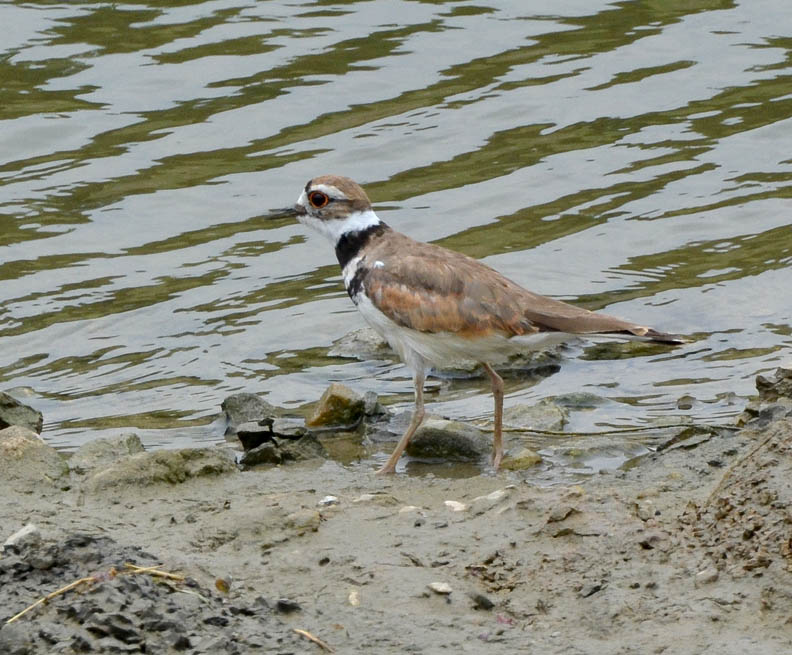
I'm not sure I can verbalize exactly why this Killdeer communicates my experience. I am probably projecting my own perceptions on it. Even after having had some time to study the photos, I still have a feeling this beautiful, wide-eyed bird was trying to re-orient itself to the changes in the post-flood river channel more than a month after the great flood of 2013.
Note: The San Antonio River Authority (SARA) has made considerable progress in reopening the Mission Reach trails damaged in the flood, however there is still much work to be done. If you are planning to visit the Mission Reach during the 4th of July holiday, please check SARA's website where there is an update with a link to a map showing current trail closures.
Tuesday, March 26, 2013
The emphasis in the previous post, "Ecosystems Are Not Abstract Concepts," was clearly on the wildflowers currently blooming along the Mission Reach of the San Antonio River. The riparian habitat restoration began with the reconfiguration of the geomorphology of the river channel. This was quickly followed by establishing a diverse growth of vegetation to stabilize the soil and provide food for a wide variety of fauna.
As I pointed out in the post on Sunday, February 3, 2013, "The Measure of Success, A Sunday Special Edition," both the total number of birds and the high diversity of their species now living along the river are among the best indicators of the effectiveness of this process thus far.
Also, one primary objective of the restoration process is to provide habitat for the migratory birds along the Central North American Flyway. The Blue-winged Teal and Yellowlegs are two birds that are in this category.
Here are four of the numerous species of birds I encountered on my walk yesterday:
- The first three photos are Blue-winged Teal. These teal will soon likely be headed north for the summer, but a few are content to remain in the area year-round.
- The fourth through sixth photos are a Lesser Yellowlegs. This is another bird that will likely be searching for cooler weather to the north for the summer.
- The seventh through the ninth photos are a Killdeer. The killdeer are content to put up with our crazy weather year-round.
- The tenth through fourteenth photos are a Great Blue Heron. The great blues also stay year-round. From what I have seen, these birds are the most territorial of all the river birds. I have a feeling they put up with our weather all year simply because they aren't about to risk losing a prime nesting site to any other bird. Whenever I see a great blue up fairly close, I always get the impression they are the "angry old man" shouting "Get off my lawn!"
Friday, March 8, 2013
San Antonio River, Mission Reach, Confluence Park Trailhead downstream
Today's photos:
I was anticipating Spring while I was on this walk. I suspect nature was anticipating the impending change in the weather with another approaching cold front. There had already been enough sprinkles to get things damp earlier in the day. The forecast was for heavier rain later in the weekend.
- Photo one is a Texas Thistle.
- Photos two and three are Pink Evening Primrose with a few rain drops remaining on their petals from the sprinkles earlier in the day.
- Photos four and five are Huisache flowers.
- Photo six is a Mealy Blue Sage.
- Photo seven is a Little Blue Heron flying upstream, apparently with somewhere to go. It will reappear momentarily.
- Photos eight through eleven are a Loggerhead Shrike. It was keeping a watch over the river and finding lots of flying insects to eat.
- Photos twelve and thirteen are two Red-winged Blackbirds perched in a Sycamore tree. The sycamores are beginning to set their leaves.
- Photos fourteen through sixteen are The Three Amigos: (l. to r.) a Great Blue Heron, a Snowy Egret and the Little Blue Heron. These birds are typically very competitive when it comes to territory, so I was surprised to see them standing this close together.
- Photo seventeen is a close up of the Great Blue Heron.
- Photos eighteen through twenty are a Killdeer. He was on a rock not very far downstream from the three amigos, but far enough away that it didn't appear to be part of the group.
- Photo twenty-one is a White Prickly Poppy.
Monday, February 25, 2013
San Antonio River, Mission Reach, Concepcíon Park Trailhead
the downstream loop trail
Today's photos:
The weather story today here in Bexar County was the high wind. This afternoon while I was walking, the wind was blowing at about 28 mph sustained with gusts between 40 and 45 mph. There were a few grass fires around the area (one with fatalities), but falling trees and blowing debris were the bigger problems.
It seemed to me the River greenway trail was probably the safest place for a walk. The primary disadvantage was there are few windbreaks along the open river channel. Holding the camera steady enough to take the photos was quite a challenge at times. But then, just standing up in the higher wind gusts was also a challenge.
In spite of the wind, I still took at least as many photos on this walk as I usually do on any walk along the River. This is just a sample. There are enough photos for two more posts in the near future.
- The first two photos are Purple Threeawn. The wind was furiously lashing the grass around almost flattening it to the ground at times.
- In the third and fourth photos, the tall dense stand of Cattail provided a windbreak on the river bank. A couple of Northern Shovelers, a few Gadwalls and a Little Blue Heron took advantage of a respite from the wind in its shelter.
- The fifth and sixth photos are of a Pink Evening Primrose. Like all the other plants, this flower was taking a fairly severe beating as the wind whipped it around.
- The seventh and eighth photos are a Snowy Egret.
- The ninth through thirteenth photos are two Lesser Yellowlegs. There were several lesser yellowlegs feeding in the wind whipped water flowing down one of the riffles.
- The fourteenth and fifteenth photos are a male Gadwall swimming in the rough, wind blown water at the center of the River channel.
- The sixteenth and seventeenth photos are of three Killdeer. Along with the lesser yellowlegs, there were numerous killdeer. In the sixteenth photo, the killdeer that was flying higher above the water was having some difficulty navigating a wind gust, but it landed on a rock without any apparent difficulty. (They showed some planes landing at SA International Airport on the evening news. The large jumbo jets seemed to be having similar problems as they approached the runway.)
- The eighteenth photo is a Loggerhead Shrike. It had a tight grip on the tree branch. If shrikes are concerned about such things, this one was definitely having a "bad feather day."