Sunday, February 3, 2013
The Measure of Success
"That land is a community is the basic concept of ecology, but that land is to be loved and respected is an extension of ethics. … We abuse land because we see it as a commodity belonging to us. When we see land as a community to which we belong, we may begin to use it with love and respect. … Examine each question in terms of what is ethically and aesthetically right, as well as what is economically expedient. A thing is right when it tends to preserve the integrity, stability, and beauty of the biotic community. It is wrong when it tends otherwise." - Aldo Leopold
 |
| 1 |
 |
| 2 |
 |
| 3 |
 |
| 4 |
 |
| 5 |
 |
| 6 |
 |
| 7 |
 |
| 8 |
 |
| 9 |
 |
| 10 |
 |
| 11 |
 |
| 12 |
 |
| 13 |
 |
| 14 |
 |
| 15 |
 |
| 16 |
 |
| 17 |
This past week I have had the pleasure of being involved in several programs dealing with various aspects of the San Antonio River Mission Reach and the River Restoration Project. To end the week, yesterday morning (Saturday, February 2, 2013) I participated in a birding hike sponsored by the San Antonio River Authority.
The photos in this series are from that hike. During the morning, we covered the area roughly bounded by Lone Star Blvd to the north, the western half of Roosevelt Park then south along Mission Rd to the railroad tracks just north of U.S. 90 and the San Antonio River Greenway to the west.
The goals of the San Antonio River Restoration Project are philosophically and ethically consistent with the Aldo Leopold quote with which I opened this post. One of the primary goals of the project is to provide habitat for birds that migrate along the Central North American flyway.
One measure of the success of the project is the number of birds that can already be found along the Mission Reach, even though the project is far from completion. In a sense, these birds are the "canaries in the coal mine" that indicate the habitat improvement is working.
Yesterday a total of twenty seven species of birds plus one sparrow of unidentified species (not a house sparrow were sighted. The photos presented here include thirteen of those twenty seven species:
- The first photo is a spotted sandpiper. This particular sandpiper has its spotless winter plumage.
- Photos two and three are a 'Myrtle' yellow-rumped warbler.
- Photo four is an European starling. These birds were first introduced to New York City in 1890 and have since spread throughout the entire continental United States.
- Photo five is a house finch.
- Photo six is a house sparrow landing at the top of a twig. Growing up in St. Louis, we referred to these as English sparrows which indicates their Eurasian origin. Like the starling, they were introduced from Europe. They have spread worldwide.
- Photo seven is a red-tailed hawk. This hawk was in the process of building its nest and can be seen carrying a twig in its beak in this photo.
- Photo eight and nine are a little blue heron. There were a pair of them on the river yesterday. This pair has returned to Bexar County a little early this year. They usually don't return until mid-March.
- Photo ten is a great egret. They are year around residents. The river wouldn't be the same without them.
- Photo eleven is a loggerhead shrike perched at the top of a tree seventy to seventy five yards away from the camera. I wouldn't have been able to identify this shrike based solely on this photo, but fortunately, we did get a better look at it while we were there.
- Photo twelve is a pair of gadwalls. There were at least five or six pair on this section of the river yesterday.
- Photo thirteen is a great blue heron. Great blue herons are close cousins of great egrets. Both are in the Genus Ardea.
- Photo fourteen is a neotropic cormorant.
- Photo fifteen is another red-tailed hawk. There was a pair of these hawks nesting on top of a cell phone tower.
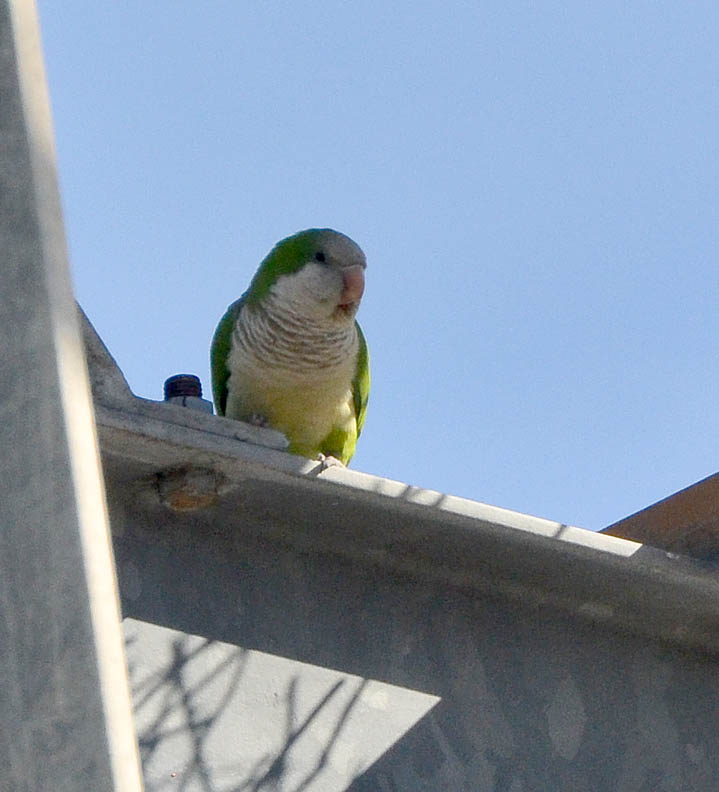
- Photos sixteen and seventeen are feral monk parakeets. These parakeets are native to central South America. They were first introduced to the United States in 1967. Feral colonies are becoming increasingly common throughout the East Coast and Gulf Coast states. There is a flock of them nesting in an electric transmission station on Mission Rd.
Note: This post has been updated, 5 February 2013 at 3:15 PM, from the original to correct the number of species sighted on this bird hike.
Friday, February 1, 2013
San Antonio River, Mission Reach, Roosevelt Park Trailhead
once around the Roosevelt Park loop trail
Today's photos:
Yesterday and today I assisted the San Antonio River Authority with a Mission Reach education program for high school students. Since I was already at Roosevelt Park this afternoon, it made sense to go once around the loop one more time for my walk today.
The first photo is a red-tailed hawk.
The second, third and fourth photos are bluebonnet plants, the State Flower of Texas, that will soon be blooming.
The fifth photo is a red-eared slider turtle.
The sixth photo is an orange sulphur or one of its close cousins.
The seventh photo is one double-crested and two neotropic cormorants.
The eighth photo with the top of the Tower of the Americas in the background is of a hawk. It is soaring high above the river at a good distance upstream from where I was walking. I think this is the red-shouldered hawk that nests close to the Alamo St bridge.
The ninth photo is of four slider turtles squeezing onto a single rock as slider turtles are prone to do to soak up the warmth of the sun.
The tenth photo is a mealy blue sage in the process of blooming.
The eleventh, twelfth and thirteenth photos are of a gulf fritillary gathering nectar from a cultivated variety of scarlet sage.
The fourteenth and fifteenth photos are a huisache tree at the intersection of Lone Star Blvd and Mission Rd. This huisache is in full bloom.
The sixteenth photo is of an Anacua tree, more commonly known as a sandpaper tree because of the very rough undersurface of the leaves. The leaves of the anacua have actually been used as a fine grit sandpaper.
Thursday, January 31, 2013
The highlight of my walk along the Salado Creek Greenway on Monday (January 28, 2013) was a very large flock of black-bellied whistling ducks. In addition to the less than ideal light from the overcast sky, an additional complication involves the editing of all the photos I took of this flock.
One bird in particular provided an excellent opening in publishing this large set of photos. I think there are two qualities of this species of duck that are generally the most noteworthy: they are ducks that don't quack and they are spectacularly beautiful in flight.
While I was photographing the flock, a number of the birds took flight, but there was one in particular that stood out from all the others: