As I mentioned in yesterday's post, there is a stand of trees along the San Antonio River Mission Reach not far downstream from the U.S. 90 bridge where birds of many kinds tend to congregate. To the left of the Red-tailed Hawk and below it on the same snag, sat a Northern Mockingbird. I'm still not quite sure what to make of this coincidental pair of "birds of prey":
If you think a Mockingbird (The Official State Bird of Texas) is NOT a bird of prey, you've likely never seen one swoop down and grab an insect off the ground, not to mention seen one attack a larger animal (including people) that it felt was threatening its territory.
This set of photographs was taken along the San Antonio River Mission Reach on Wednesday, December 4, 2013.
Showing posts with label Northern mockingbird. Show all posts
Tuesday, December 17, 2013
Sunday, April 7, 2013
Woodpecker and Mockingbird
Thursday, April 4, 2013
On my walk along Leon Creek last Monday (April 1, 2013), there were more birds in addition to those on the oxbow lake. Three in particular were quite cooperative (or at least totally ignored my presence) while I photographed them. One of these three I will post later. For now, here are a Golden-fronted Woodpecker and a Northern Mockingbird:
Thursday, February 7, 2013
Where Three Watersheds Divide
Wednesday, February 6, 2013
Eisenhower Park, Cedar Flats > Yucca Trails
Today's photos:
Today's walk was through the southern, lower elevation half of Eisenhower Park. This park was the second in the San Antonio Parks and Recreation Department system to be designated as a Natural Area. Friedrich Wilderness Park was the first with that designation.
Eisenhower Park is located in north central Bexar County within the Edwards Aquifer Recharge Zone. The park also occupies a unique and critical topographic location in that its rain runoff drains into three of Bexar County's five major watersheds. Rain water runoff that drains from the southeastern and southern boundary of the park, which is the major amount of runoff from the park, enters the Olmos Creek / San Antonio River watershed. This is the northern most direct source of that watershed.
Runoff that drains to the east from the northeast corner of the park enters the Salado Creek watershed. Runoff draining to the west from the northwest corner and western boundary enters the Leon Creek watershed. Of course, both the Salado Creek and Leon Creek are tributaries of the San Antonio River with confluences in south Bexar County, so all of the runoff eventually ends up in the San Antonio River.
The long range development plan of the Parks and Recreation Department includes the extension northward of the current Salado Creek and Leon Creek Greenway trails to have them converge at a common location in Eisenhower Park. The completion of that plan is a long way off in the future, but is something to look forward to having in place.
Today's photos are a brief glimpse of all the images that I have from this walk. There will be two more upcoming posts with more specific topics.
If all goes according to plan, tomorrow's post will be "A Bloomin' South Texas Winter."
Eisenhower Park, Cedar Flats > Yucca Trails
Today's photos:
Today's walk was through the southern, lower elevation half of Eisenhower Park. This park was the second in the San Antonio Parks and Recreation Department system to be designated as a Natural Area. Friedrich Wilderness Park was the first with that designation.
Eisenhower Park is located in north central Bexar County within the Edwards Aquifer Recharge Zone. The park also occupies a unique and critical topographic location in that its rain runoff drains into three of Bexar County's five major watersheds. Rain water runoff that drains from the southeastern and southern boundary of the park, which is the major amount of runoff from the park, enters the Olmos Creek / San Antonio River watershed. This is the northern most direct source of that watershed.
Runoff that drains to the east from the northeast corner of the park enters the Salado Creek watershed. Runoff draining to the west from the northwest corner and western boundary enters the Leon Creek watershed. Of course, both the Salado Creek and Leon Creek are tributaries of the San Antonio River with confluences in south Bexar County, so all of the runoff eventually ends up in the San Antonio River.
The long range development plan of the Parks and Recreation Department includes the extension northward of the current Salado Creek and Leon Creek Greenway trails to have them converge at a common location in Eisenhower Park. The completion of that plan is a long way off in the future, but is something to look forward to having in place.
Today's photos are a brief glimpse of all the images that I have from this walk. There will be two more upcoming posts with more specific topics.
- If I had to select one photo that illustrates the vegetation of the Edwards Plateau ecoregion, it would probably be the first one in this series. Growing low to the ground in the foreground are several Twisted-leaf Yucca plants. This species of yucca is only found as a native plant on the Edwards Plateau. Behind the twisted-leaf yucca are several Sotol, another plant characteristic of the region. And behind the sotol is an Ashe Juniper sapling. To the right of the ashe juniper is the sapling of a deciduous hardwood, but I'm not certain which species it is.
- The second, third and fourth photos are a Shiny Flea Beetle (Asphaera lustrans). This is another creature where I wonder how it got its common name. It is obviously a shiny beetle, but it has nothing at all to do with fleas.
- The fifth photo is a snail shell. Based on personal observation, I know this is one of the very common snails in Bexar County and it has a beautiful shell, but that is about the limit on my knowledge of snails. It looks like a Striped Rabdotus (Rabdotus alternatus), but don't quote me on that.
- The sixth, seventh and eighth photos are of an Eastern Cottontail Rabbit (Sylvilagus floridanus). I have seen cottontails in Eisenhower Park before, but they have all been back in the brush. This one sprang across the trail right in front of me, stopped right as it entered the undergrowth and looked back at me for a minute or two before hopping off down the hill as if it had somewhere it needed to be.
- The ninth and tenth photos are of the ubiquitous Northern Mockingbird (Mimus polyglottos). I was thinking this was going to end up being a walk without a bird sighting, but this mockingbird was apparently waiting for me next to the parking lot wen I returned to my car. When a creature poses for a photo, I can't easily pass up the opportunity.
If all goes according to plan, tomorrow's post will be "A Bloomin' South Texas Winter."
Wednesday, January 30, 2013
Another Look At the State Bird of Texas
Wednesday, January 30, 2013
Due to a very full schedule, I was unable to go for a walk today. However, I did get a brief, behind the scenes glimpse of how the Texas State Legislature works. So, it seems fitting to me this evening to publish another series of photos of the State Bird of Texas, the Northern Mockingbird:
This set of photos was taken on my walk along the Mission Reach of the San Antonio River on Wednesday, January 9, 2013.
Due to a very full schedule, I was unable to go for a walk today. However, I did get a brief, behind the scenes glimpse of how the Texas State Legislature works. So, it seems fitting to me this evening to publish another series of photos of the State Bird of Texas, the Northern Mockingbird:
This set of photos was taken on my walk along the Mission Reach of the San Antonio River on Wednesday, January 9, 2013.
Tuesday, January 29, 2013
A Few More Birds Along the Salado Creek Boardwalk
Tuesday, January 29, 2013
Here are a few more birds that I photographed on my walk along Salado Creek yesterday (Monday, January 28, 2013).
As I mentioned in yesterday's post, one of the major complications I had to deal with was the fact that the overcast sky combined to produce both a dim light and a pronounced background glare. It made it difficult to see, much less photograph, especially, the smaller birds. I think this difficulty is more pronounced in this series than it was in yesterday's:
Here are a few more birds that I photographed on my walk along Salado Creek yesterday (Monday, January 28, 2013).
As I mentioned in yesterday's post, one of the major complications I had to deal with was the fact that the overcast sky combined to produce both a dim light and a pronounced background glare. It made it difficult to see, much less photograph, especially, the smaller birds. I think this difficulty is more pronounced in this series than it was in yesterday's:
The first three and last two photos in the series are a loggerhead shrike. From the time I started the walk until I returned about an hour and a half later, this shrike was still perched in the same location on the wire.
The fourth, fifth and sixth photos are a Audubon's yellow-rumped warbler.
The seventh, eighth and ninth photos are the State Bird of Texas, the northern mockingbird.
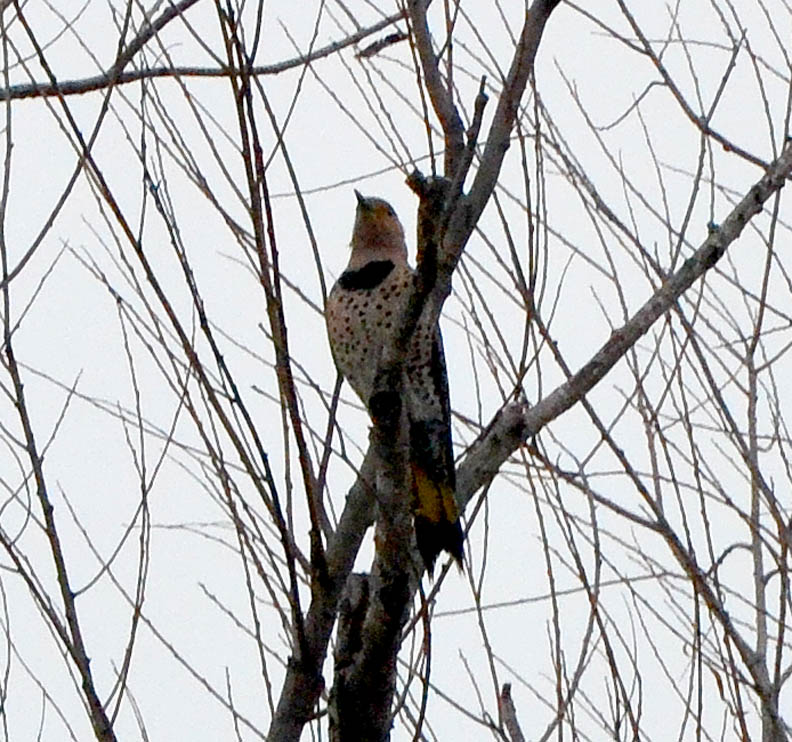
And the tenth, eleventh and twelfth photos are a northern flicker.
Monday, January 14, 2013
Birds of Crescent Bend, Part 2
Monday, January 14, 2013 *
Today's photos are from my walk at Crescent Bend Nature Park on Monday, December 17, 2012:
There are 437 species of birds listed on the San Antonio Audubon Society's checklist of birds that have been reported to have been sighted in Bexar County. I am fairly good at spotting and photographing the birds, but I am still learning to identify many of the species.
I find the sparrows especially difficult to distinguish one species from another. With that in mind, I think the first bird in this series is a savannah sparrow. The next two birds are an eastern phoebe and a house finch. The fourth bird is another sparrow that I think is a Lincoln's sparrow.
The two photos following that are of the same bird. The best I can tell, it appears to be a house wren. Then there is a black-crested titmouse, a northern cardinal and a northern mockingbird.
The last five photos are all of the same sparrow. It appears to me to be another Lincoln's sparrow.
* Due to the full schedule I have this week taking a class, all the posts for the week will be from previous walks.
Today's photos are from my walk at Crescent Bend Nature Park on Monday, December 17, 2012:
There are 437 species of birds listed on the San Antonio Audubon Society's checklist of birds that have been reported to have been sighted in Bexar County. I am fairly good at spotting and photographing the birds, but I am still learning to identify many of the species.
I find the sparrows especially difficult to distinguish one species from another. With that in mind, I think the first bird in this series is a savannah sparrow. The next two birds are an eastern phoebe and a house finch. The fourth bird is another sparrow that I think is a Lincoln's sparrow.
The two photos following that are of the same bird. The best I can tell, it appears to be a house wren. Then there is a black-crested titmouse, a northern cardinal and a northern mockingbird.
The last five photos are all of the same sparrow. It appears to me to be another Lincoln's sparrow.
* Due to the full schedule I have this week taking a class, all the posts for the week will be from previous walks.
Subscribe to:
Posts (Atom)