Tuesday, July 9, 2013
Elmendorf Lake Park
Today's photos:
Elmendorf Lake is one of numerous critical ecological resources in the City of San Antonio and the San Antonio River watershed. The Lake and Bird Island serve as a major nesting and breeding site for both year around and migratory birds. The duck, heron and hawk species that winter over in Bexar County have flown to their summer nesting grounds. Cattle Egrets, Green Herons and Cliff Swallows have settled in for the summer.
The ecosystem around the Lake is capable of supporting a diverse biological community in spite of numerous water quality and invasive plant issues that have plagued the Lake for decades. The Elmendorf Lake Improvement Project will preserve the bird habitat, including Bird Island, and address the ecological issues. The Project also provides an added benefit of creating an excellent resource for watershed ecology education.
- The first photo is a view looking across the Lake with Bird Island in the foreground. The beautiful Sacred Heart Conventual Chapel and the twin spires of the Main Building at Our Lady of the Lake University are in the background.
- The second photo is a detailed view of Bird Island. The high population of egrets and cormorants is clearly evident in this photo.
- The third photo is of a Broadleaf Cattail inflorescence. Cattail are monoecious plants having separate male and female flowers on the same plant. The female flowers here are the easily recognized "cat tail." The male flowers are higher on the stalk at the top of the photo. The cattail are widely distributed native plants that have a tendency to dominate a wetland habitat creating a monoculture if not controlled. There is an over abundance of cattail growing along the bank of the Lake.
- The fourth photo is a Creeping Water-Primrose (Ludwigia peploides (Kunth) Raven). This is a different species of Water-Primrose than the one I have photographed along the San Antonio River which is Ludwigia octovalvis (Jacq.) Raven.
- The fifth photo is a Green Heron.
- The sixth through ninth photos are of a Neotropic Cormorant taking flight from the surface of the Lake.
- The tenth through twelfth photos are of Trumpet Creeper. This vine is growing on a Black Willow tree on the bank of the large island.
- The thirteenth photo is one of beautiful, large Bald Cypress trees growing along the bank of the large island.
- The fourteenth photo is a Red-eared Slider Turtle swimming in the Lake.
- Also in the fourteenth photo: One of the ecological problems in the Lake is the tendency to have algal blooms, especially in the summer, due to the lack of water circulation and the high levels of nutrients from runoff following rain events. The very high concentration of algae is clearly visible in this photo. The decaying algae falls to the bottom and rapidly depletes the dissolved oxygen creating dead zones below the water surface.
- The fifteenth photo is a Fox Squirrel munching away on Bald Cypress cones.
- The sixteenth photo is a view of Bird Island as seen looking east from the SW 24th St bridge.
- The seventeenth through twentieth photos are Cliff Swallows flying out over the Lake from their nests under the SW 24th St bridge.
- The twenty-first photo is of two Double-crested Cormorants sitting on top of a tree on Bird Island. According to multiple sources, Double-crested Cormorants are rarely seen in Bexar County during the summer, but I have seen several both here at Elmendorf Lake and along the San Antonio River the past couple months.
- The twenty-second through twenty-fourth photos are Cattle Egrets with their very distinctive breeding plumage. There are also Great Egrets and Snowy Egrets nesting on Bird Island, but the Cattle Egrets currently are the most numerous.
* I am resisting the temptation to take While on a Walk in a distinctly academic direction. I have given much thought to the concept of "Critical Ecological Resources" this week. I realized this evening, I have another book to add to my list of "Books in Progress."
Friday, July 5, 2013
San Antonio River, Mission Reach, Confluence Park Trailhead downstream
to the 3.6 mile marker*
Today's photos:
On this long 4th of July holiday weekend, here is a set of photographs to celebrate life:
- The first photo is an Alamo Vine flower.
- The second photo is a Snowy Egret searching for food at the top of a riffle.
- The third photo is an inflorescence of Sideoats Grama (the State Grass of Texas). A tiny caterpillar of some sort has woven itself inside a web pulling the spike of the inflorescence into an oval. I would have liked to have seen how the caterpillar accomplished this.
- The fourth and fifth photos are of a Little Yellow butterfly on Orange Milkweed flowers. These milkweed blossoms were attracting numerous butterflies. Another common name for this plant is Butterfly-Weed, for obvious reasons.
- The sixth photo is a Bordered Patch butterfly on the Orange Milkweed.
- The seventh photo is a Bordered Patch butterfly on a Maximilian Sunflower. The Common Sunflowers have been in bloom for a couple of months, but the Maximilian Sunflowers are just beginning to flower.
- The eighth and ninth photos are of a Yellow-crowned Night-Heron.
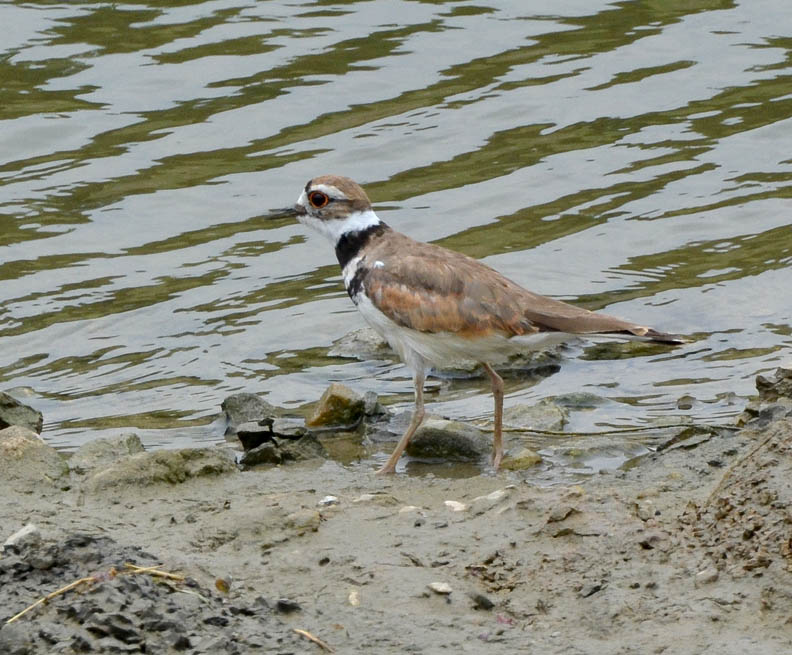
- The tenth photo is a Killdeer.
- The eleventh photo is a Neotropic Cormorant.
- The twelfth photo is a Blue-fronted Dancer (Argia apicalis) damselfly I managed to photograph inflight. This damselfly was being very cooperative while I took its photo as it hovered in more or less the same location until I turned away.
- The thirteenth photo is a slider turtle sunning itself on the recently exposed bedrock along the riverbank. From this distance the rock appears to be a relatively soft limestone aggregate. This section of the bank on the west side of the River just south of the Theo Ave bridge was severely eroded by the May 25th flood, but it revealed this fascinating rock formation.
- The fourteenth through sixteenth photos are of Partridge Pea flowers.
- The seventeenth photo is a Standing Cypress that is still in bloom.
* Along the San Antonio River Greenway Trails, there are small, roughly three inch diameter circular bronze insets with a number embedded in the center of the trail generally every two-tenths of a mile. These numbers indicate the distance in miles from the center of Main Plaza downtown. So, the 3.6 marker on the east bank trail south of Theo Ave. is 3.6 miles along the trail from Main Plaza.
The mile markers, beginning with zero, also are located north of Main Plaza. If one started at the 2.4 marker north of downtown and walked downstream to the 3.6 marker south of Theo, the total distance walked would be six miles (2.4 miles + 3.6 miles).
Monday, July 1, 2013
San Antonio River, Mission Reach, Mission Rd Trailhead downstream
Today's photos:
I really have been out taking a plethora of photos since April, even if there has only been one post since Earth Day. As the saying goes, there has been a lot of water under the bridge since then. Quite literally, there was a whole lot of water under the bridge during the major flood on May 25th with a record setting high crest on the San Antonio River under the Loop 410 South bridge.
The phrase "water under the bridge" typically refers to something in the past that is no longer important. All that has transpired since April 22nd is in the past, but still has significance both in the consequences of the events and in the lessons that must always be learned.
If all stays on course, I will discuss some of those events, their consequences and the lessons learned in an upcoming post. I have learned much in the past three months. For now, suffice it to say I did take a short walk along the River on Monday. I observed much, but took few photographs compared to my usual walks.
I'm not sure I can verbalize exactly why this Killdeer communicates my experience. I am probably projecting my own perceptions on it. Even after having had some time to study the photos, I still have a feeling this beautiful, wide-eyed bird was trying to re-orient itself to the changes in the post-flood river channel more than a month after the great flood of 2013.
Note: The San Antonio River Authority (SARA) has made considerable progress in reopening the Mission Reach trails damaged in the flood, however there is still much work to be done. If you are planning to visit the Mission Reach during the 4th of July holiday, please check SARA's website where there is an update with a link to a map showing current trail closures.
Friday, June 21, 2013
Hardberger Park, Oak Loop Trail
Today's photos:
Given all the rain that has fallen here the past couple months, the vegetation is about as green and lush as I've ever seen it along the Oak Loop Trail in Hardberger Park. I walked the trail today in preparation for leading a nature photography hike tomorrow morning.
Photography is the art of selection and elimination. Everything included in the frame of a "good" photograph should work together to communicate a unified theme. Generally, there is one dominant object or small set of objects that establish the theme of the photograph in much the way a topic sentence establishes the theme of a paragraph. Whether the photographer intends it or not, the viewer will interpret every else in the photograph in relation to the dominant object(s).
- The first photo is a Snapdragon Vine.
- The second photo is Two Leaved Senna.
- The third photo is a Common Buckeye in flight. I always try to take at least two and usually three to five frames of a photograph with slightly different focus in each frame, but sometimes, like this photo, there is only time to get one frame. This was one of the "lucky" ones were it worked.
- The fourth through sixth photos are a Texas Rose-bellied Lizard. Sometimes the animals cooperate. in this case, the lizard had run out on the trail in front of me, saw me coming then turned around and ran back to the top of a stump where it let me take a series of photos.
- The seventh and eighth photos are Zexmenia flowers.
- The ninth photo is a study in contrasting texture with the bark of a Live Oak tree in the foreground and an Ashe Juniper immediately behind the Live Oak.
- The tenth photo is a detail of a Tasajillo cactus with a small spider web woven on it.
- The eleventh and twelfth photos are blossoms on a Velvet-leaf Mallow.
- The thirteenth and fourteenth photos are a Sleepy Orange butterfly.
- The fifteenth photo is of the flowers on the top of a Whitebrush, also known as Beebrush. The way the sunlight was striking the flowers caught my eye initially, but I also realized fairly quickly there were no bees on the flowers. Given the well publicized declining bee population this is particularly worrisome. As the common name implies, theses flowers are particularly attractive to bees. These flowers appear barren without at least a few bees on them gathering nectar.
- The sixteenth and seventeenth photos are a Northern Mockingbird perched on the dead branch of a tree. There is only a slight, but significant difference in the composition of the two photos. In both, the bird and the tree are the related dominant objects. The first photo isolates the bird and the tree with only a hint of the distant horizon along the bottom of the frame. The second photo has the same basic theme, but includes more information. This particular tree is located on the side of a hill and is in an open area (there are no other trees close by surrounding it).
- The eighteenth photo is the inflorescence of Silver Bluestem.