Wednesday, July 31, 2013
Medina River Natural Area,
El Chaparral > Nogales > Rio Medina > El Camino trail loop
Today's photos:
It is that time of year again in South Texas when everyone is beginning to wonder if Autumn will ever arrive and bring cooler weather. In spite of the seemingly endless high temperature and to some extent, because of the high temperature, the South Texas landscape retains a vibrant character. My intense curiosity and passionate love of Nature irresistibly draw me out to experience the rich beauty of her elegant living tapestry:
- The first three photos are of a Snowy Egret feeding in the pond beside the El Chaparral Trail.
- The fourth through sixth photos are of Purple Threeawn. The inflorescence has fully matured losing its characteristic purple color and is beginning to disarticulate.
- The seventh and eighth photos are of fully ripe, bright orange Granjeno berries.
- The ninth photo is of a Turkscap patch with a couple of Common Wild Petunias peeking out in the center of the patch. The Turkscap are one of the more abundant flowers blooming in the hot, dry weather right now providing a rich source of nectar that will help the pollinators survive through the harsh South Texas summer.
- The tenth photo is a Common Mestra butterfly on Canadian Wildrye.
- The eleventh through fourteenth photos are of a Gulf Fritillary butterfly enjoying the Turkscap nectar.
- The fifteenth photo is a Cloudless Sulphur butterfly on an Alamo Vine flower.
- The sixteenth and seventeenth photos are a Turkey Vulture soaring high overhead.
- The eighteenth photo is the shell of a freshwater mussel with a couple of river worn rocks on a mat of algae at the edge of the river.
- The nineteenth photo is an overview of the Medina River. This is the large pool looking upstream form the "River Crossing" interpretive area.
- The twentieth photo is a Texas Rose-bellied Lizard.
Friday, July 26, 2013
San Antonio River, Mission Reach, Roosevelt Park trailhead
Today's photo:
The Texas heat high is building and taking firm hold as it typically does this time of year. High temperatures will likely remain in the upper 90s to low 100s (F) for the remainder of the summer. Surface water of any kind, especially flowing water like the San Antonio River, literally becomes very attractive to wildlife.
- The first and second photos are of the characteristic mature inflorescence of Sideoats Grama (the official State Grass of Texas). The detail in the second photo shows the alternate spikelets hanging down from the stem.
- The third and fourth photos are of Maximilian Sunflowers. In the third photo, a Paper Wasp (Polistes sp.) is flying toward the sunflowers. This stand of Maximilian Sunflowers is close to ten feet tall.
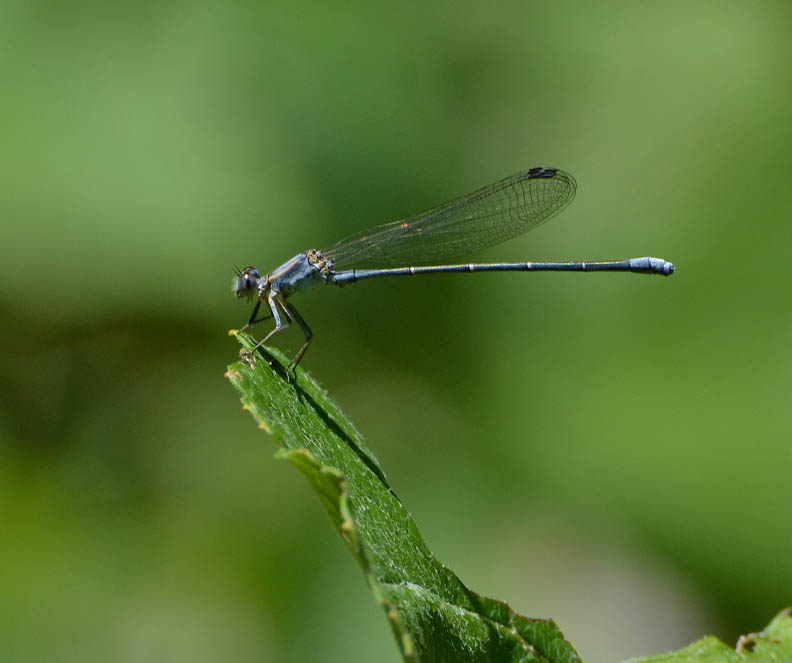
- The fifth and sixth photos, the best I can tell, are of a female Powdered Dancer damselfly (Argia moesta). The female Powdered Dancer can easily be mistaken for a male Blue-fronted Dancer, but this one looks more like the Powdered Dancer to me.
- The seventh through tenth photos are of Ceraunus Blue butterflies on Brazilian Vervain. There are two varieties of Ceraunus Blues. These are the Southwest variety. It is worth noting, the Brazilian Vervain (Verbena brasilienses Vell.) is a native, as the name implies, to South America. It has been sold widely in the U.S. as a landscape plant that has become a nuisance invasive crowding out the native Texas Vevain (Verbena halei Small).
- The eleventh and twelfth photos are of a Yellow-crowned Night-Heron quietly watching over its section of the river. This bird has been living here since mid-May. I have seen it on one of these rocks every time I have walked by since then.
- The thirteenth photo is a pair of Mourning Doves enjoying an afternoon on the riverbank.
- The fourteenth photo is a Fox Squirrel having an afternoon picnic in the shade of a Honey Mesquite tree. It isn't visible in this photo, but the squirrel was having a feast on the mesquite bean seed pods scattered on the ground under the tree.
- The fifteenth photo is a general overview of the vegetation on the west side of the River. There is an American Sycamore tree growing among the rocks at the end of the weir. This is probably a volunteer, although the sycamore is one of the more common trees being planted in the restoration project. Sycamore do very well in riparian areas. If one looks closely, a Great Egret can be seen feeding along the riverbank just left of center in the photo.
- The sixteenth and seventeenth photos are of a Neotropic Cormorant drying its wings in the sun as cormorants have to do. Cormorants dive and remain submerged under the surface of the water for relatively long periods of time while they are fishing. To make this more efficient, their feathers are not coated with oil the way many other water birds, such as ducks, are coated to keep their feathers dry. Therefore, the cormorants must hold their wings out to let them dry following a dive.
Thursday, July 18,2013
San Antonio River, Mission Reach, San Antonio Missions National Historical Park,
Mission San Juan Capistrano, Yanaguana Nature Trail
Today's photos:
The River was the source of life that attracted the Coahuiltecans to live along its banks. They called it the Yanaguana. When the Spanish arrived and began to settle in the area and establish the Missions, it was for the same reason. Rivers are living, dynamic systems, the source of water that supports all of life. The history of this River over the past four hundred years is quite complex, but it continues today to be a source of life and refreshment.
Other than damage to one of the boardwalk sections of the Yanaguana Nature Trail closest to the river channel, this trail not only survived the rain and flooding of late May, the surrounding natural area is flourishing. The rain in June and July has been infrequent and widely scattered as is typical for this time of year. The mid-summer heat has arrived, so the (relatively) cool air of the riparian woods is quite refreshing:
- In the first photo, I was photographing an Alamo Vine with its purple centered white flower growing among a cluster of red flowered Turks Cap when...
- In the second photo, a female Ruby-throated Hummingbird flew in to take advantage of all the nectar in these flowers.
- In the third and fourth photos, my attention shifted from the flowers to the Ruby-throated Hummingbird.
- The fifth through eleventh photos are of a Fatal Metalmark butterfly on a Goldeneye flower. The highly reflective metallic markings on this butterfly's wings are clearly visible in most of the photos in this series. This cluster of Goldeneye was almost 6 feet tall at its highest flower. This particular flower was at about 5 feet, so just a few inches below my standing eye level.
- Photos twelve through fifteen are a small sample of the damselflies that were abundant along the riverbank section of the trail. I haven't had time to definitively identify the species of the ones pictured here, so I'll let it go at that.
- Photo sixteen is a juvenile Yellow-crowned Night-Heron.
- Photo seventeen is a Viceroy butterfly. This is one of the butterflies that can easily be confused with the Monarch.
- Photo eighteen is a Purple Leatherflower.
- Photo nineteen is the bright, translucent red berries on a Pigeonberry.
- Photo twenty is a female Black-bellied Whistling Duck with her three offspring. If one looks very close, there is a dragonfly flying above the head of the last duckling on the right. This photo was taken looking north from E Ashley Rd. These ducks are in the diversion channel from the main flood control river channel to the original pre-channelized river bed below Mission San Juan.