Showing posts with label snowy egret. Show all posts

Thursday, March 31, 2016

One Critical Thing These Three Share

Thursday, March 31, 2016

A good question to ask a class to begin a discussion might be: "Which of these species is not like the other two?"


The most obvious answer would be the turtles. But, among many other things, the Red-shouldered Hawk has a different way of catching its prey than the Red-eared Slider turtles and the Snowy Egret. So, there really isn't one simple answer to the question: which of these is not like the other two?

There is, however, one thing in particular that all three species share in common: the river. All three depend on the riparian habitat of the river for food, water, shelter and space: for survival.

These photos were taken along the Mission Reach of the San Antonio River upstream from the upper Mission Road trailhead to just past the pavilion on Monday, March 14, 2016.

Click on the first photo in a post to open the photos in slideshow view.

Tuesday, March 15, 2016

Sometimes There Are the Surprises

Tuesday, March 15, 2016

While walking along the Mission Reach of the San Antonio River, there are countless plants and animals that one can expect to see almost all the time, such as the ubiquitous Snowy Egret:


Sometimes there are the surprises, like this pair of Hooded Mergansers:


These photos were taken on a walk along the Mission San Juan, Mission Reach loop trail on Wednesday, March 2, 2016.

Click on the first photo in a post to open the photos in a slideshow view.

Thursday, March 3, 2016

Winging It

Thursday, March 3, 2016

A Snowy Egret winging its way upstream over the river:


"The more often we see the things around us -
even the beautiful and wonderful things -
the more they become invisible to us.
That is why we often take for granted the beauty of this world:
the flowers, the trees, the birds, the clouds -
even those we love.
Because we see things so often,
we see them less and less."
- Joseph B. Wirthlin

These photographs were taken on my walk along the Mission Reach of the San Antonio River downstream from the VFW Blvd trailhead on Monday, February 15, 2016.

Thursday, February 25, 2016

Watching the River Flow

Thursday, February 25, 2016

Sometimes even the Snowy Egret, Great Blue Heron and Yellow-crowned Night Heron like to just stand and watch the river flow by:


The Great Blue Heron shown above really does have two legs. Most bird species, not just Flamingos, will stand on one leg and tuck the other leg up against their body when they remain standing for an extended period of time. It is an efficient way to conserve energy.

These photographs were taken on my walk along the Roosevelt Park loop trail of the Mission Reach of the San Antonio River on Monday, February 22, 2016.

Saturday, February 20, 2016

February "Snow" in San Antonio

Saturday, February 20, 2016

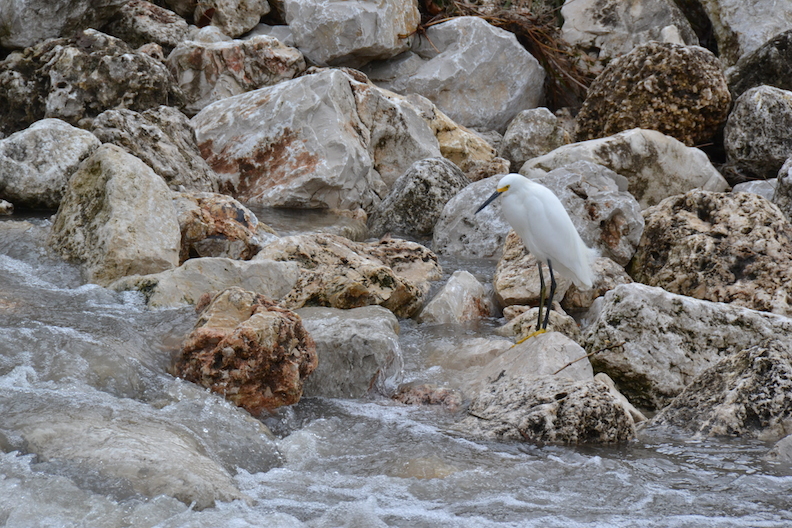
Snowy Egrets live year round in Bexar County. The Mission Reach of the San Antonio River provides an excellent restored habitat for these splendid birds. They find much to eat along the riffles, along the shallow banks of the river and in the quiet backwater of the embayments:


This February has been unusually mild so far, but weather can change abruptly here in South Texas, so with a month of winter left, I hope I'm not speaking too soon. It is highly unlikely we will see anything resembling real snow this winter. The Snowy Egrets are as close as we typically get to seeing anything "snowy" here in South Texas.

These photographs were taken on my walk along the Mission Reach of the San Antonio River downstream from the VFW Blvd trailhead this past Monday, February 15, 2016.

Tuesday, July 8, 2014

A Stampede of Cattle Egrets

Cattle Egrets (Bulbucus ibis) are fairly recent arrivals to the Western Hemisphere. They first arrived in Florida from South America by way of the Caribbean Islands around 1953 and have rapidly spread north and west since then. Cattle Egrets are now well established year round residents in South Texas.

These birds are generally found in large flocks in upland areas particularly where cattle grazing is common as they have a commensal relationship with large, grazing herbivores of all kinds. It is not unusual, however, to find their breeding rookeries close to streams and lakes. With the ecological restoration beginning to take hold along the Mission Reach of the San Antonio River, flocks of Cattle Egrets are beginning to be sighted on and near the banks of the river:


There are at least three distinguishing characteristics that differentiate the Cattle Egret from the other two white egrets, the Great Egret and Snowy Egret, that are also commonly seen along the Mission Reach. Cattle Egrets have red-orange feathers on the top of their heads and the top of their backs. Cattle Egrets have yellow or orange beaks, yellow legs and yellow feet. And Cattle Egrets are almost always seen in large flocks while the other two egret species are generally solitary or in pairs. For comparison, here are a Great Egret on the rock to the left and a Snowy Egret just past the weir to the right:


I probably should note that in the photo of the pair flying close together, it appears as if their feet are black. This pair had just taken off from the muddy river bank, so their feet still have a thin coating of mud on them making them appear darker than they really are.

This set of photographs was taken on my walk along the Mission Reach on Wednesday, July 2, 2014 about a third of a mile or so north of the Loop 410 bridge.