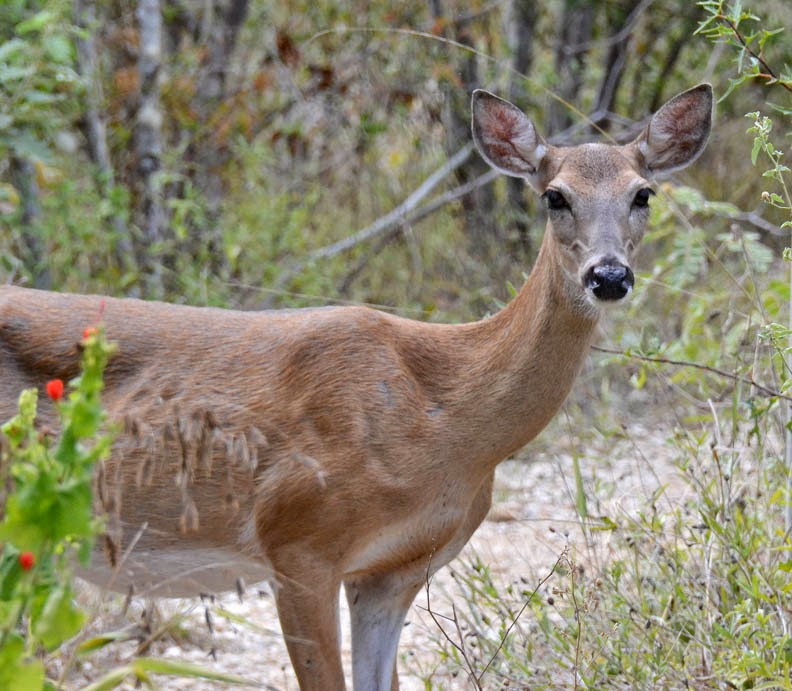
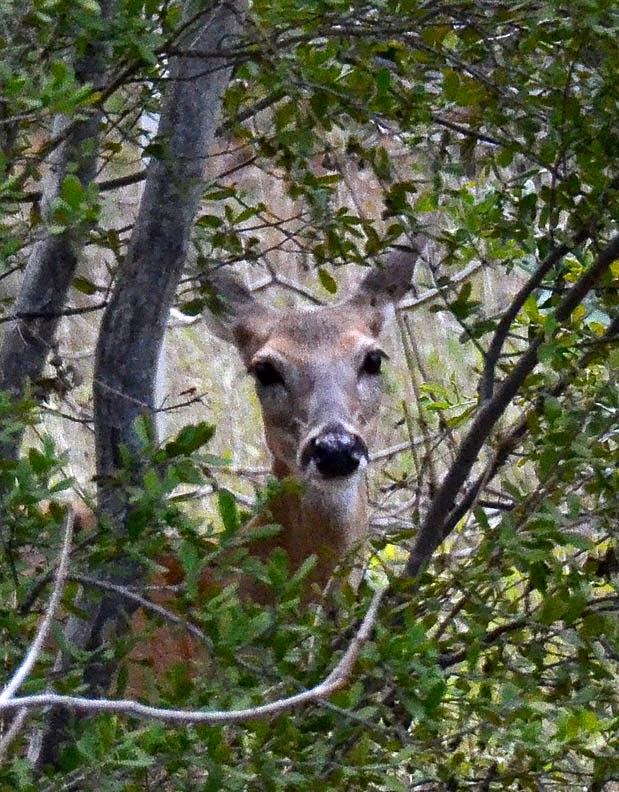
White-tailed Deer are a fairly common sight along the Panther Spring Creek trail at Walker Ranch Historic Landmark Natural Area. So are photographers. This young doe was acting as if she had never seen a photographer before and was very curious about what I might be doing. There were at least two other deer with her that wouldn't come out of the brush:
On the other hand, she probably had never seen a human with strange long front legs (my fore-arm crutches) before and was curious about how I walked.
This set of photographs was taken along the Panther Spring Creek trail at Walker Ranch Historic Landmark Natural Area on Wednesday, September 11, 2013. These photos are all of the same doe. The other two deer were too well hidden by the brush to photograph.
The recent rain has been a very welcome change in the weather. The first major cool front of the season is forecast to arrive just in time for the first day of Autumn on Sunday. One of the best indicators that Fall is fast approaching are the beautiful yellow flowers beginning to open on the Lindheimer's Senna:
Monday, March 18, 2013
Red Buckeye is prolific along Panther Spring Creek in Walker Ranch Historic Landmark Natural Area. This shrub sheds its leaves in mid to late summer, but rapidly develops large leaf buds. These buds remain dormant until late winter.
Early in March, the buckeye rapidly sets its new leaves and begins to blossom with red flowers that resemble exploding firecrackers. Thus, another common name for this buckeye is Firecracker Plant. On my walk along the Panther Spring Creek Trail last Wednesday (March 13, 2013), the buckeye stood out among the surrounding vegetation. Some of the shrubs were just beginning to set new leaves, while others where in full bloom:
Thursday, March 14, 2013
Goatweed Leafwing sounds like the perfect name for a cartoon character, but it is actually the name of a butterfly. The host plants for their caterpillar are crotons, such as the Texas Croton. One of the common names for croton is goatweed.
The goatweed leafwing I photographed on my walk at Walker Ranch Historic Landmark Natural Area on Wednesday (March 13, 2013) was particularly active and easy to see. Typically, these butterflies will perch with their wings folded. The underside of the wings look very much like dried leaves. This serves as a very effective camouflage:
Wednesday, March 13, 2013
Walker Ranch Historic Landmark Natural Area, Panther Spring Creek Trails
Today's photos:
The South Texas landscape never goes completely dormant during winter, but this time of year as the Spring equinox approaches, new plant growth becomes vividly apparent and the fauna become more active.
- The first photo appears to me to be an Eastern Phoebe. This isn't the best angle and lighting for identifying birds and I really didn't get a much better look at this one when I was taking the photos, but from what I can see, I can't think of a more likely possibility of what it could be.
- The second photo is a Black-crested Titmouse.
- The third photo is a Lesser Goldfinch.
- The fourth photo is Scarlet Sage, also known as tropical sage.
- The fifth photo is the top of a Cedar Elm (also known as fall elm) that is setting new leaves.
- The sixth photo is Huisache. There were so many huisache blooming, the fragrance from the flowers filled the air along the trail. An extract from these flowers is a common ingredient in perfume.
- The seventh and eighth photos are Prairie Verbena. These verbena are blooming here and there, but aren't yet as abundant as they were last year.
- The ninth photo is the top of another Cedar Elm tree.
- The tenth and eleventh photos are close up views of one of the branches of the cedar elm in photo nine. These two photos show a better view of the emerging leaves.
- The twelfth photo is an overview of the vegetation along Panther Spring Creek. The large tree on the opposite side of the creek is a Cedar Elm. The most common trees in this area are the cedar elm, the live oak and the Texas red oak.
- The thirteenth, fourteenth and fifteenth photos are Tasajillo, also known as Christmas cactus.
- The sixteenth photo is a female Northern Cardinal.
- The seventeenth and eighteenth photos are close ups of newly emergent Cedar Elm leaves.